With the U.S. in Venezuela, What Happens to Global Oil Economy?
If the United States succeeds in exercising control over Venezuela, which, going by the statement of U.S. President is just a matter of some more days, and exercises control over the largest proven oil reserve of the world, the world will not be the same.
GEO SHORTSGEO POLITICSHOME PAGEGEO SECURITY
Team GTP
1/5/20263 min read
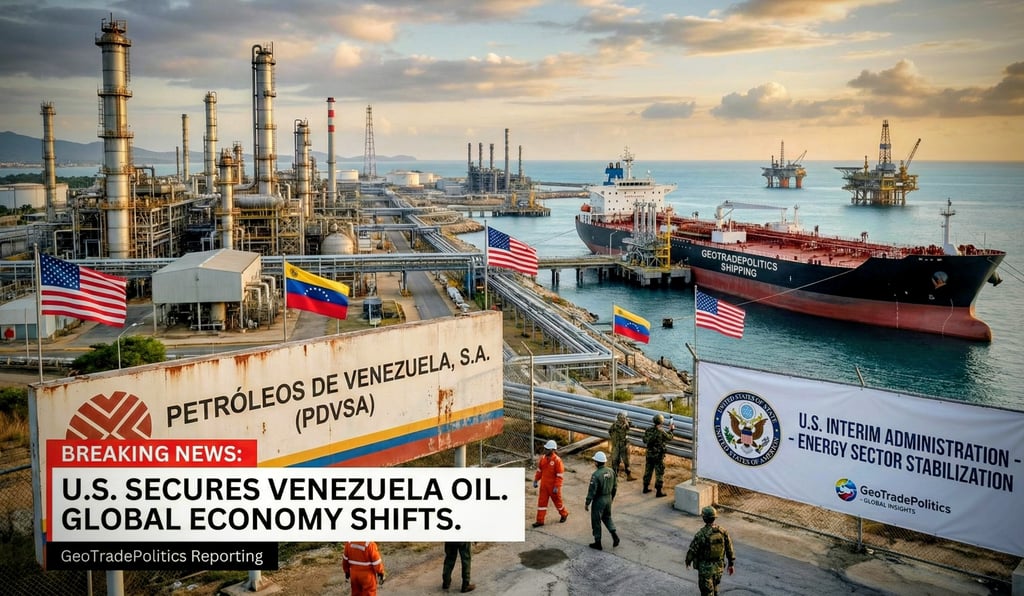
U.S. President Donald Trump has made it clear that the United States will run Venezuela after the capture of its president Nicolas Maduro until ‘safe, proper and judicious transition'.
Trump also has noted that the U.S. will play role in the oil industry of Venezuela. Trump has said that he is not afraid of putting ‘boots on the ground’ even as the nations across the globe have taken the Venezuela development differently.
Many analyses are coming meanwhile.
If the United States succeeds in imposing control over Venezuela, which, going by the statement of U.S. President is just a matter of a few more days, and exercises control over the largest proven oil reserve of the world, the world will not be the same. It is going to witness a major shift in global power with the U.S. having the key of control.
A few days back, China had come up with a revision of its Foreign Trade Law with an aim to make itself stronger and more resilient in its trade war with the United States, particularly after President Trump’s tariff. China has aligned itself with major international trade bloc—members of the Comprehensive and Progressive Agreement for Trans-Pacific Partnership (CPTPP).
At present the group has 12 members—Australia, Brunei, Canada, Chile, Japan, Malaysia, Mexico, New Zealand, Peru, Singapore, the UK, and Vietnam, which form a major free-trade bloc in the Indo-Pacific region.
With the control of Venezuela, the U.S., on the other hand, would be gaining direct access to the world’s largest proven oil reserve there.
Washington has Iran to deal with too. There is already a domestic unrest going on in Iran against the cleric regime of Ayatollah Ali Khamenei. The Shah of Iran, Mohammad Reza Pehlavi too is in the forefront along with the people in the movement against the cleric rule.
Years of economic sanctions by various countries, particularly the U.S. and the West have broken the backbone of Iran’s economy.
Iran is a big producer of petroleum and by controlling Venezuela, the U.S. will be very big international player in the oil sector. This situation directly affects the economy of the Arab oil-producing nations, Russia and Iran.
In the event of a confrontation with Iran, the U.S. will have a reduced vulnerability to energy disruptions in the Gulf now that the U.S. will control oil industry in Venezuela.
Besides, the Venezuelan control will strengthen the United States’ ability to shape global oil price and flow. United States is exercising all its ability to keep its international trade dominance, as well as the dominance of its Dollar. Last few years, the anti-US bloc, led by BRICS had been trying to evolve an alternative international payment system to minimize the dominance of the Dollar. In the event of U.S. control of Venezuela, the anti-U.S. bloc’s effort will be cut to size. The effort to evolve a unipolar world would further be met with challenges now.
The opposite also could be possible.
If the U.S. gets too much engrossed in Venezuela, and faces the possibility of resistance the people from within Venezuela, it would have to bear losses. In any case, Trump’s statements suggest that the U.S. would be installing a friendly administration there, instead of running the country itself for long.
All eyes are therefore now fixed on how long the Venezuelan crisis would drag the U.S. as well as other powers of the world, who have been or would be responding in their own ways.
Meanwhile, Maduro has been taken to New York and faces hearing according to the U.S. laws, scheduled for Monday. Maduro has been charged of running a drug trafficking racket, a charge he has denied. Maduro had been saying that the U.S. wants Venezuelan oil, and had even offered U.S. investment in Venezuelan oil industry.
Nations around the globe have asked the U.S. to deal Venezuelan crisis with international law.
French Foreign Minister Jean-Noel Barrot wrote on X, “The military operation that led to the capture of Nicolas Maduro violates the principle of not resorting to force, that underpins international law. France reiterates that no lasting political solution can be imposed from the outside and that only sovereign people themselves can decide their future".
Russia urged US to release Maduro and his wife. In a statement issued by the Russian foreign ministry, Moscow has said, “In light of confirmed reports that Venezuelan President Nicolas Maduro and his wife are in the United States, we strongly urge the American leadership to reconsider its position and release the legally elected president of a sovereign country and his wife".