Why is EU-India Trade Deal being called ‘Mother of All Trade Deals’
Luxury cars and European wine is what the Indians have come to be loving to consume. Love for car and wine are indications of changing lifestyle in India, which Europe understands.
GEO ANALYSISGEO POLITICSGEO TRADEHOME PAGE
Aman Kumar
1/27/20263 min read
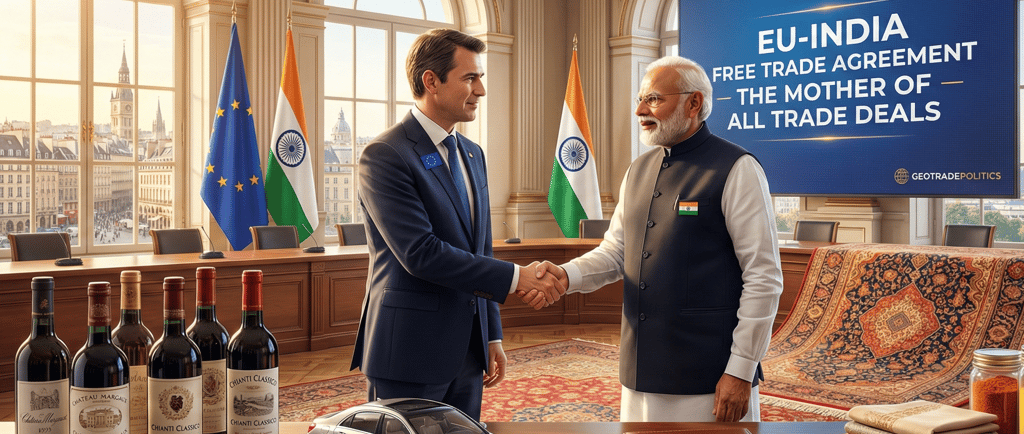
“Mother of All Trade Deals” is how the free trade agreement between European Union and India being described, which is expected to be announced on Tuesday, a day after the Republic Day celebrations in India.
European Commission President Ursula von der Leyen who attended the national celebrations of India as the chief guest noted that it was an "honour of a lifetime", and that a "successful India makes world stable", marking the importance the two trading partners are attaching to the free trade agreement.
Why is It the ‘Mother of All Trade Deals’?
Both Europe and India—two big geographical regions are blessed with rich cultural past and a long history of mutual trade in human history.
While the great Magadha Mourya Empire (around 400 BCE) that stretched upto Afghanistan, according to Al-Baruni’s India, was giving way to Gupta period and then to Indo-Greek kingdoms and the Indo-Scythians (Sakas), Roman Empire was coming up in Europe, passing through the era of Alexandar, whose empire stretched upto Egypt and India.
Ancient India and Europe of the Roman era shared a significant luxurious trade, primarily via sea routes (Red Sea, monsoon winds) and overland paths, exchanging Indian spices, textiles, pearls, gems, and indigo for Roman gold, glassware, wine, and coral, creating immense cultural exchange. The trade is supposed to have been very strong upoto the second century CE, following which Rome started getting strained by the trade.
In later days during the Mughal era, India came to be known for its wealth and grandeur, following which a systematic capture by the British took place as the rulers of India, though many other European nations did reach India.
History comes full circle when India-Europe trade deal reminds the trade historicity between the two geographical regions.
Today, the 27-member EU form a very large and influential economic unit. The 2026 projection make the EU's GDP estimated to be approximately $22.515 trillion.
India on the other hand is a growing economy at present estimated to be worth $4.3 trillion. According to reports, Indian housewives alone own gold measuring 35,000 tonnes, valued at over $5 trillion. This, apart India is a yet-to-be-tapped nation with a huge future potential. Britain that exited EU, has signed a free trade agreement with India separately.
The Trade Scenario
The EU is India's largest partner for goods trade, with total bilateral trade around $136 billion in 2024-25.
Europe’s exports to India majorly include high-end industrial machinery, aircraft, pharmaceuticals, organic chemicals, electrical equipment cars, whiskey and other luxury goods. India exports to Europe include textiles, electronics, pharmaceuticals, chemicals, and base metals, spices, tea, and seafood, jewelry, and handicrafts.
What European Cars the Indians are Crazy for
India’s car consumption is a highly growing sector that a trade partner would like to be delighted with, once free trade agreement is a reality. Apart from Indian giant car maker like Tata Motors and Mahindra, Indians use brands like Hyundai, Suzuki, Toyota and Kia—all of which are non-European in origin.
However, market for high-end luxury car brands like BMW, Mercedes, Audo, Volvo too is fast growing in India. But high tariff by India makes the car costlier. At present, the tariff on imported cars is 100%, which is expected to come down to 40% as being discussed after the agreement.
European wine is another luxury that Indians love to consume.
Both car and wine are indication of changing lifestyle in India, which Europe understands.
Meanwhile, India’s labour-intensive sectors like textile, spices, tea, seafood, jewelry and handicrafts are expected to get a new lease of life with the Europe-India trade agreement.
Textile and handicraft had particularly been hit and large number of people affected after the U.S. imposed huge tariff on India.
If one takes, for example, the case of carpet industry in India’s most famous carpet producing region, Bhadohi known as the ‘carpet city of India’ situated near India’s capital city New Delhi, the U.S. tariff has nearly ruined the area’s livelihood.
“All the hand-made carpet manufacturers are under depression due to the tariff imposed on our country. I have cut production up to 30%. The 20 daily wage earners who worked for me earlier, lost their work,” says Piyush Barnwal, a carpet factory owner in Bhadohi.
Handicraft owners think the India-Europe trade deal will help compensate the loss they have gone through due to heavy tariff by the United States. The Bhadohi-Mirzapur region alone employs over two million people in the sector. The region produces handmade carpets and exports worth Rs 12,000 crore (13,08,308.40 US Dollar) annually.
India is a big exporter of textile goods, of which carpet industry is just a part. Germany, Britian, France and Sweden in Europe are connoisseurs of Indian handmade carpets.