What’s coming in Venezuela after Maduro Fall
The world community waits with impatience as to what is next in Venezuela after U.S. President Donald Trump announced the capture of Venezuela President Nicolas Maduro.
GEO POLITICSGEO SECURITYHOME PAGEGEO DEFENCE
Team GTP
1/4/20262 min read
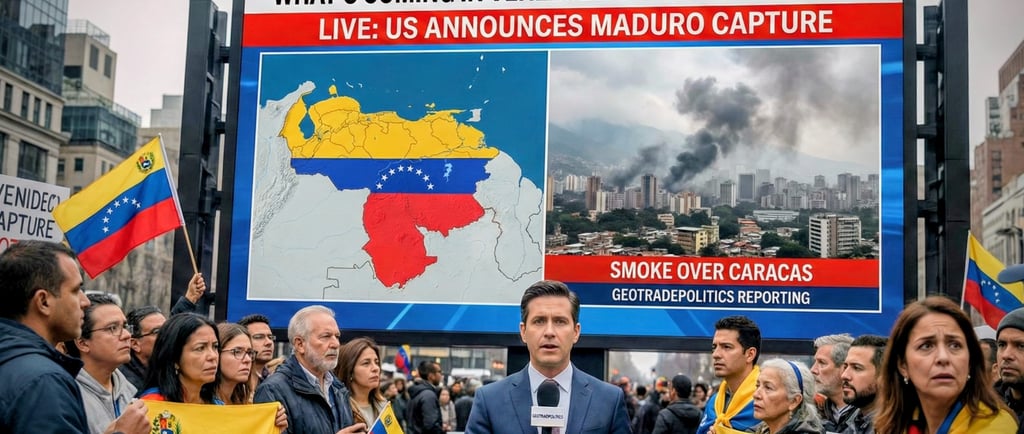
The world community waits with impatience as to what is next in Venezuela after U.S. President Donald Trump announced the capture of Venezuela President Nicolas Maduro.
The capture had been preceded by strikes upon Caracas in Venezuela, where pictures showed smokes rising up in volumes.
While many countries said they are watching the developments and turn of events in Venezuela, European Union called for a de-escalation in Venezuela and supported a peaceful, democratic solution in the country, as noted by European Council President Antonio Costa.
While Venezuelan gathered in Chile's capital, Santiago, to celebrate the news of Maduro's capture, Maduro's supporters protested in Caracas.
Vice President of Venezuela, Delcy Rodriques, who media reported quoting the sources, was in Russia, asked for proof of Maduro’s life in a video clip.
Rodriguez doubled as finance and oil minister, and is a key figure in the management of Venezuela's economy.
U.S. President Donald Trump, according to reports, has meanwhile revealed more about the operations. Trump has been quoted as saying that he was making decisions now on what's next for Venezuelan leadership.
All eyes are fixed on the Opposition leader Machado, while it is now on the U.S. as to who might be put forward to lead the troubled American nation.
Maria Corina Machado has not commented on the situation, as yet.
The Maduro government, meanwhile, has accused that the U.S. eyed on the oil in their country. The United States might well be getting more involved in Venezuela’s oil economy after a regime change there.
Earlier, the United States had been carrying out operations on Venezuelan boats suspected to be ferrying drugs. Relationship between Venezuelan President Maduro and U.S. President Trump had gone worse. Maduro, a few days back, had offered talks with the United States.
Maduro had said in a New Year’s interview that his country was open to talks with the U.S. and was willing to accept U.S. investment in the oil industry. Maduro was also open to dialogue on drug trafficking.
The United States had earlier sanctioned Venezuela’s oil, which is the most important industry for the country.
Main Economy of Venezuela
Venezuela's economy is dependent on the production and export of petroleum. Oil amounts for a huge 90-95 per cent of the American nation’s export earnings, and a significant portion of the nation’s wealth is made up of its income from the oil industry.
Venezuela is said to be the home to world’s largest oil reserves. Petroleum export is made in countries like China, Russia, and India, particularly after U.S. sanctions.
Natural gas, iron ore, bauxite, aluminum, cement, and agricultural products like rice, coffee, and fish too form the backbone of Venezuelan economy.
However, in recent years, the country had suffered from serious economic crisis characterized by hyperinflation, shortages of basic goods, and a heavy, debt-ridden, inefficient state-controlled system.
On top of all these, the U.S. sanctions had worsened the situation of the American country, and had forced to restrict itself to smaller group of trading partner countries.
Meanwhile, U.S. Vice President JD Vance noted to X, saying that Trump had given Maduro opportunities to stop "the drug trafficking". Vance’s post also said, "Maduro is the newest person to find out that President Trump means what he says.”