What if AI and Ancient Knowledge of India Like Vedic Mathematics and Yoga, Ayurveda are Integrated
While Artificial Intelligence (AI) grip the world in feverish epileptic fits, back in the East discussions are happening on an equally promising plane!
GEO ANALYSISGEO INDIHOME PAGE
Aman Kumar
2/4/20262 min read
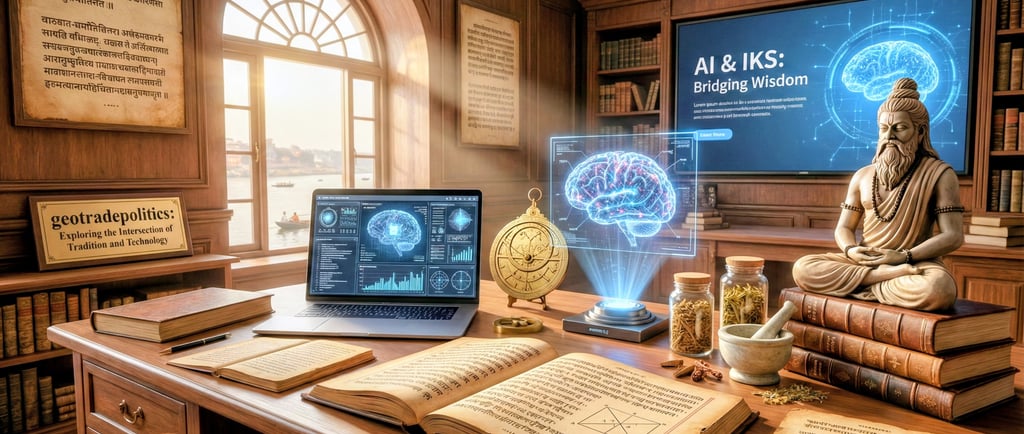
While Artificial Intelligence (AI) has gripped the world in feverish epileptic fits, and there have been reports that AI-powered chatbots have created their own community, own language and also a religion of their own, and even conversing with one another, back in India deliberations are happening on an equally interesting plane!
At some universities like Benaras Hindu University (BHU), a seat of academic learning in Norther India known for its specialization in ancient wisdom of India, discussion is on:
‘What if the Indian Knowledge system (IKS), the most ancient Indian wisdom, and the most advanced technological innovations, Artificial Intelligence (AI) come together and integrated?’
Ramesh Shukla, professor of astrology at Sampurnanand Sanskrit University, Varanasi says that “integrating IKS with AI is the need of the time. AI will help in faster calculations of Vedic mathematics; faster and accurate predictions can be made. This is the time of the AI. We must use it.”
Ancient wisdom of the East included Philosophy, Yoga, Vedic Mathematics, Vedas, Astronomy, Astrology, architecture, linguistics, and Ayurveda, environmental conservation that laid emphasis on living with nature, not destroying nature.
Back then, when technology yet to take over, experts in Vedic mathematics, astronomy and astrology, used to make predictions about natural events all by doing calculations in Vedic mathematics.
Ayurveda used to be the only means to cure people in case of ailments. The Vaidyas (doctors using traditional medicine for healing) dried the herbs and shrubs– plants and trees with medicinal properties–and prepared medicines using their knowledge that has come to be preserved in the society from generation to generation.
Coincidentally, India has managed to preserve its ancient knowledge system despite the growing prevalence of modern science.
But new technological innovations keep modern education and modern medical science ahead of the ancient Indian knowledge system.
“Collaboration of ancient knowledge system of India with AI could throw up wonders we never knew,” says Prof. Anand Vardhan Sharma of BHU.
Tech billionaire Elon Musk is who Prof. Sharma refers to, highlighting Musk’s statements and viewpoints that emphasize the transformative role of artificial intelligence in the present world.
Citing Musk’s warnings and predictions regarding AI, Prof. Sharma says the rapidly advancing technologies pose questions to both opportunities and ethical challenges. He also raises hope how traditional frameworks of thought can continue to inform present-day debates on artificial intelligence, responsibility, and the future of humanity.
But, how to go about and whom to collaborate with? This is what the academics ask next.
In recent times, there is significant, active collaboration between artificial intelligence (AI) and the ancient knowledge systems of India, aimed at preserving, digitizing, and analyzing traditional wisdom.
Key initiatives include the AI-driven Traditional Knowledge Digital Library (TKDL) for Ayurveda and Unani, AI-based Sanskrit translation tools at IIT Kharagpur, and machine learning to analyze manuscript at the Asiatic Society.
Some scholars even suggest that ancient knowledge like the Yoga can inspire creation of AI algorithm that mimic human cognitive process. Yoga’s ethical underpinning can guide AI developers to ensure that technology is compatible with human values and social well-being.