What Happens If the U.S. Goes Ahead with Its Naval Blockade
Global economic recession may already have arrived, and is making itself feel in Asia and Europe! But if the U.S. naval blockade is the next stage in the Iran war, recession would only be too obvious
GEO POLITICSGEO TRADEGEO ANALYSISHOME PAGE
Kiro S.K.
4/13/20264 min read
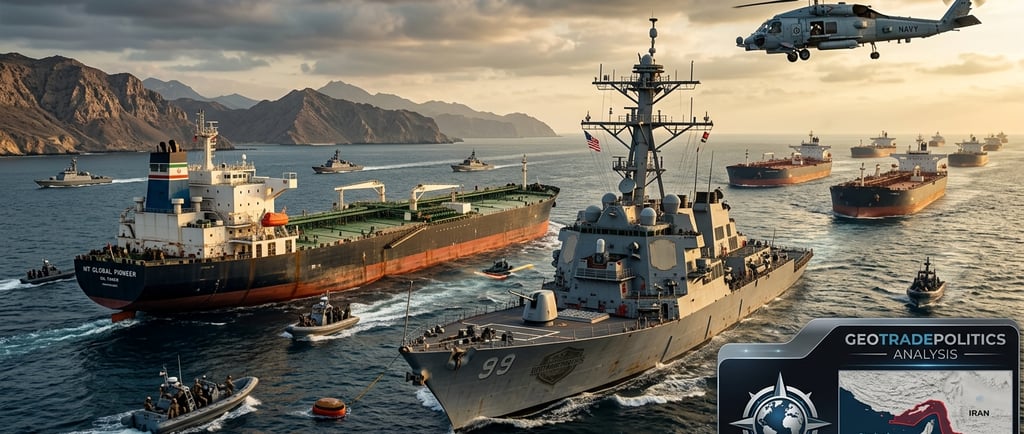
The war that began in the name of nuclear weapon in Iran, has now centred around ‘oil’—just like any other war that has taken place in the Middle-East during the past decades.
While the world reels under oil crisis and the rocketing price of oil, the war now seems to be getting concentrated at the Strait of Hormuz—with the two-week ceasefire on the verge of collapse.
U.S. President Donald Trump’s new threat of naval blockade of ships entering or leaving Iran ports at Strait of Hormuz, sounded that ceasefire was hanging on a thin string, and the war could resume any time.
According to reports quoting the U.S. Army, the US plans to enforce a blockade in the Gulf of Oman and Arabian Sea east of the Strait of Hormuz. Vessels entering or departing the blockade area would be intercepted, diverted or captured.
What does the U.S. naval blockade mean?
The U.S. naval blockade is for the blocking of ships entering and exiting Iran ports at the Strait of Hormuz in the Gulf of Oman and Arabian Sea. This means that the U.S. wants to block the oil-economy activities of Iran, and thereby hit at the economic backbone of Iran.
Iran, on the other hand, has threatened that if the U.S. went ahead blocking its oil-economy activities by naval blockade around its ports, it would strike the ports of Gulf neighbours.
What situation would the U.S.’s naval blockade of Iran ports, generate?
The U.S. will not allow oil to be exported from Iranian ports at Strait of Hormuz, and Iran will not allow oil to be exported from ports of the Gulf neighbours.
Thus, the war is now completely concentrated on oil, and that too, on the Gulf oil.
Oil prices have already surged even further after the Islamabad Peace-talks failed. Soon after the new threat of Trump on naval blockade of Iran ports at Strait of Hormuz, oil prices soared further on Monday.
Iran’s friendly countries, particularly China, would be the indirect target of the U.S.’s naval blockade of Iranian ports at the Strait of Hormuz.
However, many other countries who hugely depend upon Iran and other Gulf nations for oil like India and European countries, would be badly affected as the war now would be only on the Gulf ports and oil now.
The naval blockade threatens to throw a huge part of the globe into oil crisis.
Blocking Iranian shipments would certainly disconnect a significant source of oil from the world's markets.
The blockade of Iranian ports, however, would trigger disruption of oil exports from other Gulf nations’ ports as well, as Iran would target them.
Thus, not just Iranian oil, but oil from other Gulf countries too, would fail to reach the market.
Approximately 20-21 million barrels of crude oil and refined products are shipped daily from Gulf countries’ ports via the Strait of Hormuz. Major exporting countries include Saudi Arabia, Iraq, UAE, and others, and the sealine where the war would now get re-located, is the most crucial oil shipment zone.
The target markets of the oil export through this sealine belong to Asian countries like Japan, South Korea, China, and India being the biggest.
On the other hand, Europe gets about 0.66-million-barrel oil per day as of data for 2024, from Gulf countries, which amounts to something like six per cent of its oil imports.
No wonder, if the U.S. economic blockade of Iran oil is put on the ground, U.S.’s arch economic rival, China would be the worst hit. The U.S. might well be targeting China indirectly, which might work as a pressure upon Iran to open the Strait of Hormuz! But China is known form its electronic vehicles.
India, which depends mostly on imported oil for its energy requirement, would also be the worst hit, and a harsh economic recession looms over this Asian country.
That even Europe won’t be spared of an economic recession is for sure, if the U.S. went ahead with the planned naval blockade of Iran ports, and Iran strikes the Gulf ports.
While Iran and the Gulf nations would be directly affected by the new location of the Iran war, Asia and European countries would be indirectly affected. The United States won’t be affected directly as far as oil is concerned, but its inflation has already headed north, which would certainly aggravate.
Will the peace-talks resume?
U.S. President Trump believes that Iran will re-open the talks. But the impasse is on the Strait of Hormuz—the U.S. wants its pre-war status, while Iran does not want to forgo its new status. The new status of the Strait of Hormuz is that it is now under the control of Iran’s IRGC, and Iran has weaponized it. It is no longer just a strait; it is a crucial weapon in the war.
Meanwhile, European nations, the NATO allies of the U.S. have denied to get drawn into the new conflict. Europe seem to believe that re-opening of the Strait of Hormuz requires diplomatic path instead of military. Military option would only get things worse, and throw the whole world into a massive recession.
Iran has been maintaining that the Strait of Hormuz is “open”, but only for non-enemy countries. However, once the U.S. naval blockade begins and Iran retaliates, even the naval traffic that now passes through the strait would completely come to a standstill.
Will Europe talk to Iran separately?
As NATO allies have kept themselves aloof with a stand “not our war”, they are no enemies of Iran, and Iran might be too eager to talk to them over opening up of the Strait of Hormuz, but under the regulation of its IRGC force.
In that situation, split in NATO is most likely as Trump on many occasions earlier, has already threatened to withdraw from the alliance.
As a conclusion,
Global economic recession is feared to have already been in, and started making itself feel in Asia and Europe! But if the U.S. naval blockade is the next stage in the Iran war, recession would fast intensify its degree.