Trade Deals Re-ordering the World Trade
Two important trade deals are making news these days: one, the Canada-China trade deal and the other the European Union-India free trade negotiation being termed as ‘Mother of all Deals’.
GEO ANALYSISGEO TRADEGEO POLITICSHOME PAGE
Kiro SK
1/26/20263 min read
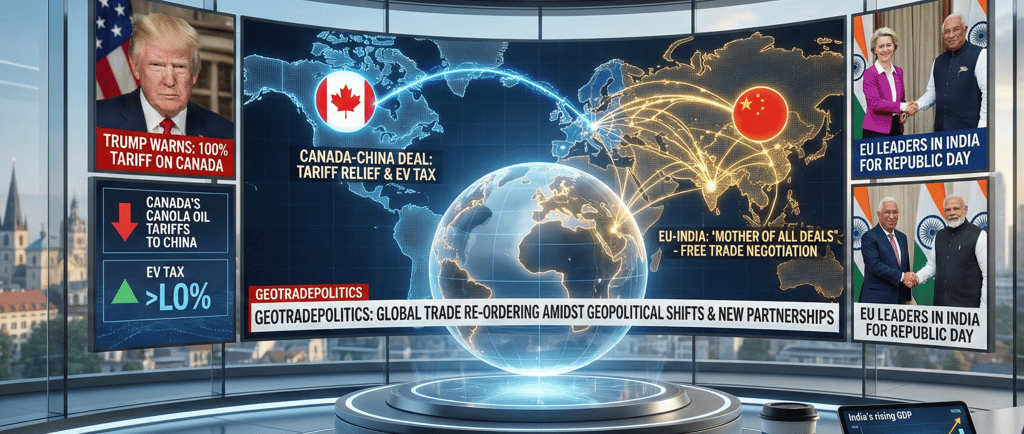
Two important trade deals are making news these days: one, the Canada-China trade deal and the other the European Union-India free trade negotiation.
While the Canada-China trade deal has invited the displeasure of U.S. President Donald Trump, the European Union-India trade deal is expected to be announced in the next few days, and it is being termed as ‘Mother of all Deals’.
A few days back, Canadian Prime Minister Mark Carney met Chinese President Xi Jinping to discuss trade and announced a tariff relief after the meeting. The two countries then announced lower tariffs, which signals a resetting of the trade relations of the two countries. China is expected to lower levies on Canadian canola oil from 85% to 15% by March 1, 2026. Canada on the other hand will tax electric vehicles at a very low 6.1% tariff.
Canada-China trade deal, which is a step between the two-countries as a partial circumvention to their traditional trade relations with the United States, has invited the displeasure of President Trump, who has threatened with 100% tariff upon Canada if it went ahead with its trade deal with China. A post in President Trump’s Truth Social said, "If Canada makes a deal with China, it will immediately be hit with a 100% Tariff against all Canadian goods and products coming into the U.S.A.".
The European Union on the other hand, is nearly finalizing a free trade deal with India, which is being termed as ‘Mother of all Deals’.
Two important leaders, European Commission President Ursula von der Leyen and European Council President Antonio Costa are in New Delhi and will be officiating as the chief guests at India’s Republic Day celebrations.
The free trade deal between EU and India—two important trading geography of the world, is expected to be announced soon after on Tuesday, January 27.
According to analysts, both the sides want reliable trade partners at a time when countries are resetting their trade order after the protectionists policies of some countries as well as the tumultuous geopolitics amidst wars, tariffs and trade competitions.
While both EU and India are looking beyond the United States, the EU also wants to lessen its dependence on countries like China by partnering with an emerging Asian country like India.
However, free trade negotiations will have to be ratified by the European Union Parliament, the process of which will, if goes well, take no less than a year.
As for India, high tariff from the U.S. has negatively impacted its export and is now looking for fresh trade partners. Its huge oil import from Russia had earlier attracted displeasure of the United States. In the recent past, the Asian country has already struck trade deals with the UK, Oman, New Zealand.
The trade deal between EU and India makes a market for nearly 2 billion people who account for a quarter of the world's GDP.
For India, the deal is expected to help its labour-intensive export-oriented production sector like gems, jewellery, garment and agriculture. India also is hoping to maximize its service sector export through the deal by sending more high-skilled professionals.
At present, India-EU trade volume has reached worth €120 billion in 2024, which is 11.5% of India's total trade.
In the recent past, European Union has already entered in trade deals with Asian giants like Japan and South Korea. The EU does not want to forgo the huge market that India offers for its goods, particularly its cars, wine and other luxury items. At present, India levies a tariff of upto 100% on cars and 150% on imported wine. The economically strong middle class is huge consumer of European cars and wine, and the size of this group in India is growing every day.
At present, the economy of India stands at 4.2 trillion dollar, and is expected to become the third largest economy in the world after the U.S. and China by 2030.