The Outcome of the U.S.-Iran Peace Deal in Islamabad will Reveal to What Degree the Geopolitics has Changed!
All eyes are fixed on the peace talk between the U.S. and Iran under the mediation of Pakistan slated to begin on Friday
GEO ANALYSISGEO POLITICSGEO SECURITYHOME PAGE
Team GTP
4/9/20264 min read
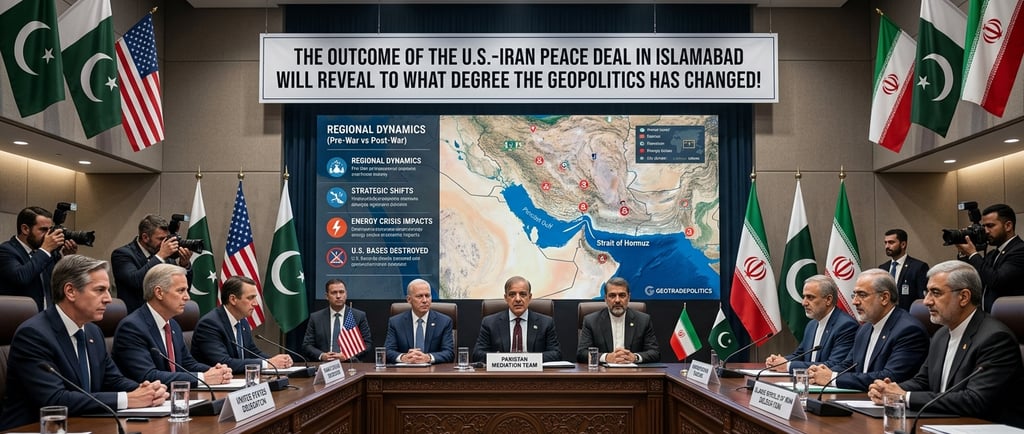
All eyes are fixed on the peace talk between the U.S. and Iran under the mediation of Pakistan slated to begin on Friday
Body: All of global eyes are fixed on the peace talk between the U.S. and Iran under the mediation of Pakistan slated to begin on Friday after U.S. President Donald Trump announced a two-week ceasefire hours before his “whole civilization will die” threat on Tuesday.
While reopening of the Strait of Hormuz is a necessary point of peace deal, Iran has placed a 10-point demand for the peace talk that the U.S. President Trump has reportedly termed as ‘workable’.
Islamabad, which is facilitating the peace talks, has reportedly fortified the area where the leaders of the two nations are scheduled to assemble for the much-watched after peace deal.
The Iran war had started on February 28 with a strike by Israel-US military forces that killed the top leadership of Iran including Supreme Leader Ayatollah Ali Khamenei. As Iran retaliated with all might, the war escalated. And as the days passed, the whole of the Middle-East became a zone with deadly strikes in which thousands were killed and many military and civilian targets including energy facilities, bridges, oil facilities were destroyed. The U.S. too lost its military bases in the Middle-East due to the Iranian missile strikes. While the U.S. strikes brought huge damage upon Iran, Iranian missile strikes caused damage and destructions to the U.S. war planes. The 40-days’ war had been the deadliest of wars in recent days, and the world witnessed clear devastation of life, property and even economy.
The closure of Strait of Hormuz, which oversaw the passage of some 20 per cent of world’s trade shipping, particularly oil and natural gas to countries of Asia and Europe, became the turning point in the war politics. As Europe and Asian nations started feeling acute energy crisis, particularly price rise and supply crisis of oil and natural gas, the warning nations came under the moral pressure of global community.
What are the possible points of the peace deal?
The actual demands of either side is not made public, though immediate re-opening of the Strait of Hormuz is a necessary agreement, which Iran has said it would do soon.
According to reports by media organisations, Iran has forwarded 10 points for the peace deal to the United States. Media organisation, Al Jazeera reported that the 10 points are likely to include, a commitment to non-aggression from the US, controlled passage through the Strait of Hormuz in coordination with the Iranian armed forces, an acceptance of Iran’s nuclear enrichment programme, lifting of all primary and secondary sanctions and resolutions against Iran, The withdrawal of US combat forces from all bases in the region, compensation for the damage it has suffered in the war, among others.
While some of the points might readily get the U.S. acceptance at the deal process, a few points, particularly things like nuclear programme, might witness hard negotiation from either side.
Along with Pakistan, China also is supposed to have made Iran agree to the two-week ceasefire leading to the peace deal.
Experts argue that Iran after the war is in a better position to negotiate the deal as it has met the U.S.-Israel joint military with incredible defence during the war.
Pakistan Prime Minister Shehbaz Sharif, in a social media post said, “With the greatest humility, I am pleased to announce that the Islamic Republic of Iran and the United States of America, along with their allies, have agreed to an immediate ceasefire everywhere including Lebanon and elsewhere, EFFECTIVE IMMEDIATELY. I warmly welcome the sagacious gesture and extend deepest gratitude to the leadership of both the countries and invite their delegations to Islamabad on Friday, 10th April 2026, to further negotiate for a conclusive agreement to settle all disputes. Both parties have displayed remarkable wisdom and understanding and have remained constructively engaged in furthering the cause of peace and stability. We earnestly hope, that the ‘Islamabad Talks’ succeed in achieving sustainable peace and wish to share more good news in coming days!”
What was the position before the War?
Iran had been nearly alienated in the world community for many decades through sanctions by the U.S. and the European Union. The main issue was its nuclear programmes, in which the U.S. and Europe maintained that Iran was busy enriching uranium for developing nuclear weapon. Iran, however, always maintained that its programmes were only civilian in nature, and not military.
Just before the war began on February 28, peace negotiations between the U.S. and Iran were going on. The two nations had already fought a war last year, though it had lasted only 12 days.
Iran, however, had been reeling under sever economic sanction by the U.S. and Europe, and the sanctions had driven its economy to a near complete ruin.
What is the position after the 40-day War?
Iran incurred a huge loss of life and property. It lost all its senior leadership. It lost many of its oil and energy facilities. But it also inflicted huge losses to U.S. bases in the Middle-East.
However, according to experts, Iran’s display of its missile technology opened up new dimension of considerations in war strategy and modern-day warfare. Despite poor air power, its missile warfare strategy brought heavy casualty to the joint U.S.-Israel military. Iran’s drone technology also opened up a new dimension in modern-day warfare and many nations would now be forced to re-think in their defence systems, and re-orient them accordingly. The superior air power of the U.S. and the air-defence system of Israel too is sure to go through a re-orientation in the coming days.
As the war has brought about massive destruction to oil and natural gas facilities in the Gulf, re-building of oil and natural gas facilities would cost time, the consequence of the war on oil supply might linger.
Has the Iran War changed the World Order?
Too early to make any conclusive statement, though some experts maintain that Iran war has shifted the geopolitics, weakening the Western influence. This expert’s view might be partly true. It however is true that the U.S. has lost a good deal of its military bases in the Middle-East. What is for sure is that Iran has emerged as a stronger regional power in the Middle-East. At the global level too, its bargaining position has increased.
As far as a shift in the geopolitics is concerned, the outcome of the peace deal would finally reveal to what degree the world-order has changed!