The Day of U.S. Blockade of the Strait of Hormuz and Global Reactions
The U.S. blockade of Iranian ports at the Strait of Hormuz is giving mixed response from the global community even as the U.S. carried out its first day’s blockade as warned
GEO POLITICSGEO TRADEHOME PAGEGEO ANALYSIS
Team GTP
4/14/20263 min read
The U.S. blockade of Iranian ports at the Strait of Hormuz is giving mixed response from the global community even as the U.S. carried out its first day’s blockade as warned.
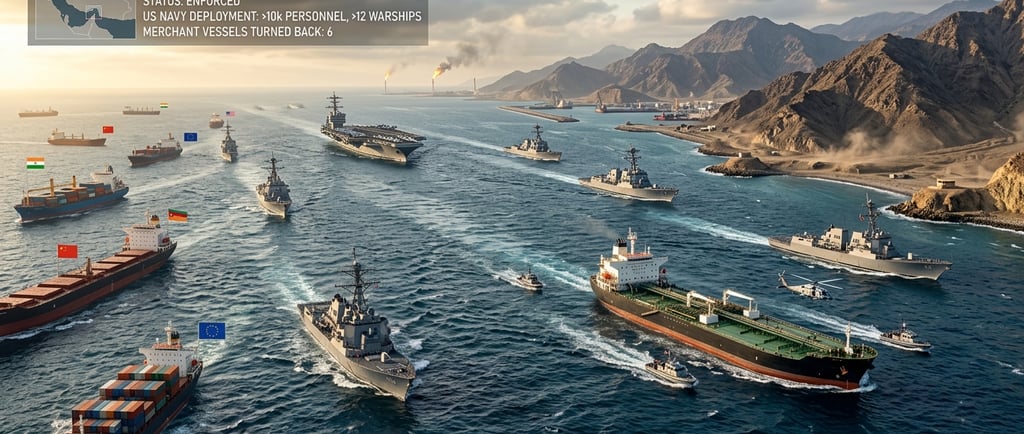
According to a post by the U.S. Central Command, the U.S. is learnt to have made massive deployment towards the blockade. The post said that more than 10,000 U.S. Sailors, Marines, and Airmen along with over a dozen warships and dozens of aircraft executed the mission. “During the first 24 hours, no ships made it past the U.S. blockade and 6 merchant vessels complied with direction from U.S. forces to turn around to re-enter an Iranian port on the Gulf of Oman,” the post by the U.S. Central Command said. It added that the blockade is being enforced impartially against vessels of all nations entering or departing Iranian ports and coastal areas, including all Iranian ports on the Arabian Gulf and Gulf of Oman.
The U.S.-Israel war with Iran is currently under a two-week ceasefire and the peace talks between the U.S. and Iran mediated by Islamabad has failed. Reports, however, suggested that Islamabad has offered a second round of talk between the two warring parties.
Meanwhile, the U.S. blockade at the Strait of Hormuz has evoked sharp responses from many quarters.
BBC quoted U.N. Secretary-General of the International Maritime Organization (IMO), a specialized UN agency, Arsenio Dominguez saying, "I do understand there is a conflict going on there, but there is still no legal basis in international law to take any actions to block any strait used for international navigation".
China, which imports huge amount of crude oil from Iran, termed the U.S. blockade of Strait of Hormuz as 'dangerous and irresponsible' even as it denied that it is aiding Iran militarily in the war.
Asian countries, particularly China, India, Japan and South Korea are the worst hit due to the blockade of the Strait of Hormuz.
While the U.S. has cleared that that it is exercising the blockade only with regard to the ships entering and leaving Iranian ports, and not for ships that enter and leave ports in other Gulf countries.
Intension of the U.S. is to carry out an economic blockade of Iran’s oil exports, thereby bring pressure on Iran for a deal favourable to it.
Iran on the other hand termed the blockade a ‘piracy’, and has said that the U.S. should honour the ceasefire.
The U.S. Central Command claimed that no ship made past the U.S. blockade.
Pope Leo
Meanwhile, the tension between U.S. President Trump and the Roman Catholic pontiff Pope Leo became too obvious with the pope on Tuesday issuing a letter on democracy.
In his letter to the participants of a Vatican meeting, the pope has raised concern, saying that democracies remained healthy only when they were rooted in moral values. Lacking this foundation, democracies risked “becoming either a majoritarian tyranny or a mask for the dominance of economic and technological elites," Pope Leo’s letter has said. The letter, however, is indirect in nature, and does not name Trump specifically though the context is too obvious.
On Sunday, President Trump, on his social media platform, Truth Social, had criticized the pope saying that the “Pope Leo is WEAK on Crime, and terrible for Foreign Policy".
Pope Leo had responded to it saying that he had “no fear of the Trump administration, or speaking out loudly". Media reports quoting the pope as saying, had stated, "I will continue to speak out loudly against war, looking to promote peace, promoting dialogue and multilateral relationships among the states to look for just solutions to problems".
Pope Leo however had clarified that he did not want a debate with U.S. President Trump, but that the Christian message, rooted in the primacy of peace, was being abused.
European Stand
U.K. and France have made it clear that they were not joining the U.S. blockade of the Strait of Hormuz even as Spain has already been taking a stand against the war, as well as against Israel’s war against Palestine.
France and UK have decided to co-host a videoconference of leaders of nations and to lead formation of a “defensive mission" that would help restore freedom of navigation in the Strait of Hormuz.
Europe has been against the war from the beginning as the bloc is being directly affected by it.
Indian Prime Minister Narendra Modi, meanwhile has said in a social media post that he received a phone call from U.S. President Trump and that they had a long discussion. Without making India’s stand clear with regard to the war, Modi in the social media post said, “We reviewed the substantial progress achieved in our bilateral cooperation in various sectors. We are committed to further strengthening our Comprehensive Global Strategic Partnership in all areas.”
Modi’s post said that they discussed situation in West Asia and that they stressed the importance of keeping the Strait of Hormuz open and secure.