Surrounded by Water, Left with Only Fluoridated Water
Fluoride Water is slowly sipping out the sap of villagers in over 269 villages of Sonbhadra, the region known as the ‘Energy Capital’ of India.
GEO INDIGEO WEATHERHOME PAGE
Team GTP
12/29/20253 min read
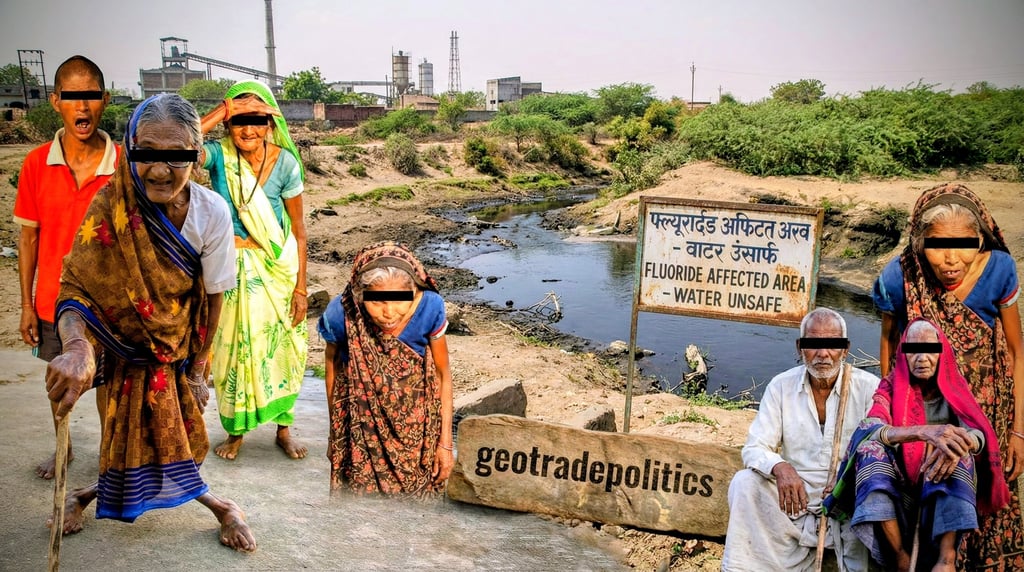
Life here is slowly dying every minute. Childhood does not run—or rather, cannot run. Adolescence looks prematurely adult, and adulthood struggles to survive.
Welcome to Sonbhadra, the second-largest district of Uttar Pradesh, a land where, as faith holds, the holiest of rivers—the River Ganga—flows, and where some of India’s largest energy giants operate. Sonbhadra is famously known as the “energy capital” of India due to its vast mineral reserves of coal, bauxite, and limestone, along with numerous power plants, including major NTPC facilities and Hindalco.
Yet beneath this industrial prominence lies a silent crisis. The water in Sonbhadra contains excessive fluoride—crippling lives, draining vitality, and pushing villagers toward funeral pyres long before they reach an age considered natural for death.
Guddu Kumar (name changed), a resident of Rohania Damar in Kachanarawas village of Sonbhadra in eastern Uttar Pradesh, is just 10 years old. But Guddu cannot run around like other boys his age. Play and sports exist only in imagination. The effects of fluorosis in drinking water have reduced him to what appears like a breathing idol. He can walk, but not without intense pain in his legs.
Guddu is not alone. In this remote village, every third family has at least two victims of fluoride contamination.
Sumitra (name changed), another resident of the locality, appears like an elderly woman, though her actual age places her on the brink of adulthood.
Tragically, Guddus and Sumitras are not exceptions—they are widespread across the region.
“Everyone knows about the excess fluoride in water in around 269 villages of Sonbhadra. This contamination is causing untold harm to the health of people living here,” says social worker Jagat Narayan Vishwakarma, who has been fighting for the rights of the locals.
“In these villages, every third family has at least two people suffering from fluorosis—some mildly, others severely. Locals have been battling this crisis for over three decades,” he adds. According to him, repeated representations to authorities have yielded nothing beyond assurances.
Yes—assurances.
Ironically, Vishwakarma himself is a victim of fluorosis. He has undergone treatment of some kind, though he chooses not to speak about it. He frequently suffers from joint pain and walks with a limp.
A visit to these villages reveals the scale of devastation fluoride has inflicted. Many children as young as 10 have discoloured teeth from consuming fluoride-laced water since early childhood. In many cases, this has resulted in permanent dental deformities.
Social worker Shubha Prem explains that fluoride’s damage unfolds gradually. “It first discolours teeth, then reduces muscle flexibility, making it difficult to stretch or bend the limbs,” she says.
She demands that fluoride-removal plants be installed in adequate numbers so villagers can access safe, potable water. She laments the failure of a country to provide even basic drinking water to its most vulnerable citizens.
Fluoridated water is a persistent problem across the region. Several villages in the Myorpur and Kon developmental blocks are affected.
Five years ago, Uttar Pradesh Jal Nigam installed fluoride-removal plants equipped with 5,000-litre tanks in some villages, engaging a private company for drinking water supply. However, coverage remains limited.
Professor Gopal Nath, a renowned microbiologist at the Institute of Medical Sciences, Banaras Hindu University, says, “Fluoride in water is harmful to health. When consumed over time, it deposits in bones and causes serious health problems. De-fluoridation plants are the only viable solution to make water safe for drinking.”
He further cautions that fluoride negatively affects children’s growth and advises people to avoid drinking contaminated water wherever possible.
Vishwakarma wrote to the state government in 2018 and again in 2019. The responses, he says, offered little more than promises.
Despite official claims that over 70 percent of the population now has access to safe drinking water, many villagers remain dependent on fluoridated sources.
Executive Engineer (Rural), Jal Nigam, Arun Singh, states that clean water currently reaches around 70 percent of the population and that the remaining 30 percent will soon be covered.
Dr. H. P. Pandey, a scientist at the National Institute of Technology, Prayagraj, warns that fluoride exposure is causing disabilities and impairing both physical and mental development. “If concrete steps are not taken immediately, the situation could worsen dramatically,” he says.
According to geotradepolitics.com analysis, Sonbhadra’s fluoride crisis highlights a deeper contradiction in India’s development model—where regions rich in energy and minerals continue to suffer from basic human development failures, exposing a gap between industrial growth and public health governance.
Fluoride
Fluoride is a widely occurring, non-biodegradable, long-term pollutant. It is released through the burning of coal bricks and is naturally present in minerals, soil, water, and air. In high concentrations, it is highly toxic.
Sonbhadra
Sonbhadra is a unique district bordering four Indian states—Madhya Pradesh, Chhattisgarh, Jharkhand, and Bihar—known for its rich history and ancient cave paintings.