President Trump visiting President Xi: “It is like, ‘It is wiser to stay closer to an enemy than to a friend’.”
Why the world’s two largest economies are, despite deep mutual rivalry and trade wars, cannot do without one another?
GEO ANALYSISGEO TRADEGEO POLITICSHOME PAGE
Kiro S.K.
2/24/20264 min read
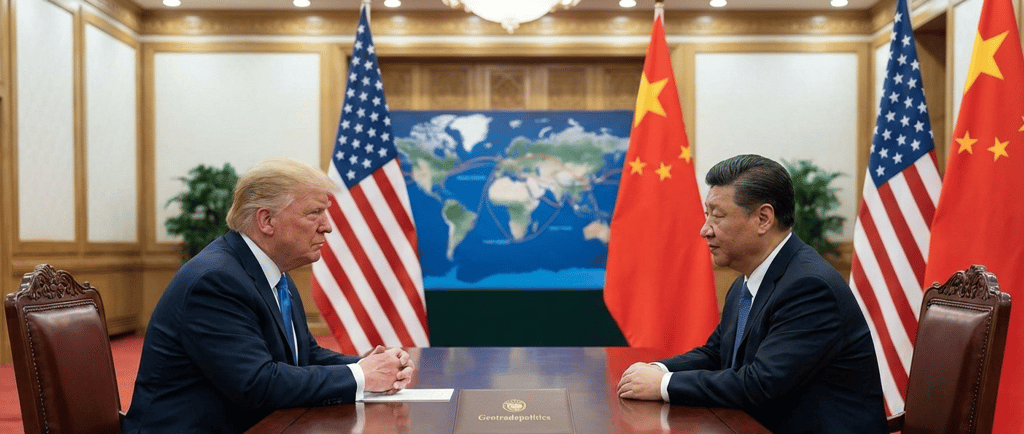
Amidst the ruling of the U.S. Supreme Court on tariffs, United States President Donald Trump is reported to be heading to China in April to meet President Xi Jinping. During the past few months, there has been lots of trade pulls and pushes between the two nations.
The questions that come are—
Why the world’s two largest economies are, despite deep mutual rivalry and trade wars, cannot do without one another?
What would be the central issues during the globally much watched meeting?
Will Taiwan issue figure as a subject at the meet?
And why China takes a guarded stand on the U.S. Supreme Court ruling in Trump’s tariff while many other nations across the globe came out openly with what they thought, and spoke their mind?
In the 20th century, oil shaped geopolitics.
In the 21st century, it’s the semiconductor. The race for AI dominance has turned microchips into strategic weapons — and trade policy into a battlefield.
A few days ago, a global AI Summit concluded in India’s New Delhi, where many world leaders including France President Emmanuel Macron, and corporate leaders like OpenAI CEO Sam Altman, and Anthropic CEO Dario Amodei, took part.
The growing usage of Artificial Intelligence has increased the importance of microchips. As the world has emerged, no big nation would like to lag behind in AI as the day is that of the AI today. As for the U.S. and China, both are vying with one another even on AI.
China is the largest consumer of microchips, and nearly 50 per cent of the world’s chips are consumed by this Asian country. Bulk of the semiconductors are imported from the U.S., though the U.S. has imposed export control on advanced semiconductors, and China is trying to develop its domestic semiconductor industry to be self-reliant.
Taiwan, the Bone of Contention
Taiwan, despite being a tiny country, manages to hold its ground even as China repeats often calling it as its own territory, and the U.S. is agreement-bound to provide security to it, because of its semiconductors.
Taiwan is the world’s sole maker of machines needed to make leading-edge chips, through its Taiwan Semiconductor Manufacturing Co.
Why Chips Matter More Than Ever
Advanced semiconductors power Artificial intelligence, Military systems, Cybersecurity infrastructure, Autonomous vehicles, and Data centers to name a few.
This is the reason what makes Taiwan geopolitically critical—a reason why Taiwan makes a high-stake country for the U.S. and China.
There is a fear that the world may possibly split into competing digital blocs: a US-led AI ecosystem, and a China-centered tech sphere.
The US-led AI ecosystem would be aimed at securing global technological dominance through a vertically integrated, "Pax Silica" alliance of trusted partners. It prioritizes high-speed, military-industrial growth, aiming for unquestioned supremacy in AI, chips, and data centers, while fostering a secure supply chain, reducing dependence on rivals.
There is going to be tight integration of U.S.-designed chips (NVIDIA, AMD), cloud providers (Microsoft, Google), and data infrastructure.
On the other hand, a China-centered tech sphere would be an integrated ecosystem dominated by AI-driven, hardware-software convergence, focusing on rapid commercialization of technologies like EVs, robotics, and smart city infrastructure. It features intense state support, prioritizing core technologies such as semiconductors, quantum computing, and green energy, aimed at defining global standards.
The ‘Give’ and ‘Take’
The US and China are locked in a complex "give and take" defined by a trade war truce, with the US reducing tariffs on Chinese goods (from 57% to 47%) and pausing further technology restrictions. In exchange, China has agreed to increase purchases of US agricultural products, pause export controls on critical rare earth minerals, and curb the flow of fentanyl components. However, the recent U.S. Supreme Court ruling has created a new scenario where the trade truce might go for a further change. China for sure would be ready with a long list of ‘what’ and ‘how; when President Trump lands in Beijing for his State visit, and high profile meet with Chinese President Xi.
The Key "Give and Take" Dynamics
The US has largely maintained high tariffs on Chinese goods, including 100% tariffs on electric vehicles, but has offered temporary pauses on further increases to ease tensions.
China has responded with its own, though sometimes adjusted, tariffs and increased buying of US soybeans and agricultural products.
However, China may change its stand with regard to U.S. soyabeans and agricultural products in the changed scenario after the U.S. Supre Court ruling on Trump’s tariff.
On the other hand, the US continues to restrict Chinese access to advanced semiconductors (like Nvidia chips) and scrutinizes apps like TikTok for national security reasons. China, in return, has at times threatened to control the supply of rare earth minerals essential to U.S. manufacturing.
However, mutual interdependence is huge. Despite the conflict, the US relies on China for supply chains, while China remains a major market for US goods and agricultural exports.
Both China and the U.S. maintain open but strained communication channel. While the U.S. administration has stated about President Trump’s China visit, Beijing has so far kept silent.
However, both of these large economies understand that they cannot do without one another, rather no one wants to keep the other from its trade loop, probably for fear that such a situation will not be a good situation for either. It is like, ‘it is wiser to stay closer to an enemy than to a friend’.