President Trump, A Dam and A River that Relates to Julius Caesar, Queen Cleopatra, Moses and His Exodus
The Dispute of Grand Ethiopian Renaissance Dam, which U.S. President Trump wants to mediate solve, involves Imperial Rome, Julius Caesar, Cleopatra and even Moses and the Exodus story of the Bible.
GEO ANALYSISGEO POLITICSHOME PAGE
Kiro SK
1/24/20263 min read
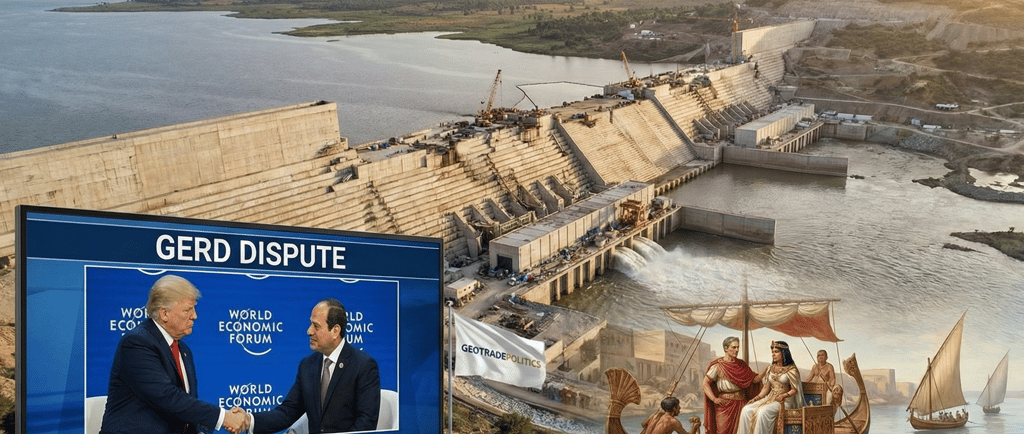
U.S. President Donald Trump, on the sidelines of World Economic Forum in Davos, Switzerland, met with Egypt's President Abdel Fattah al-Sisi and told him that he would like to bring together the leaders of Egypt and Ethiopia and get them sort out dispute over Ethiopia’s Grand Ethiopian Renaissance Dam.
The dam is a 6,450 MW hydropower project nearing completion on the Blue Nile in Ethiopia. It is located about 30 km upstream of the border with Sudan. It will be the largest hydropower project in Africa, to be owned and operated by the Ethiopian Electric Power company. The dam, according to report, is being designed for 100 years of utility, and is expected to change the socio-economic situation of Ethiopian society, which is mostly rural and agro-dependent.
However, the dam has involved in a dispute two important countries of Africa—Egypt, Sudan with Ethiopia.
What is the Dispute all about?
While Ethiopia wants to make use of its rights to develop its resource and change its socio-economic situation with the help of the Grand Ethiopian Renaissance Dam, Egypt fears that it will have a reduced Nile water supply.
Sudan’s fear if bigger. It is caught in the middle fearing both water shortages and potential dam-induced floods. Go in between are many treaties and operational agreements.
For Egypt, Nile has been its lifeline since time immemorial, going back to the days of the Moses. It looks at the upcoming dam as an existential threat for itself.
Interestingly, it was this very Nile which had turned Egypt in history as one of the richest regions in the world.
The Imperial Rome Got is Foodgrains from Egypt
Going by the account of the famous book, Contours of World Economy, authored by Angus Maddison, the Imperial Romans had their foodgrains brought from the rich agriculture region of Egypt. Egypt had the River Nile and the rich Nile Delta produced surplus foodgrains, particularly wheat.
The passionate romance of Julius Ceasar and Egypt’s beautiful queen Cleopatra is an immortal tale of 40 BCE that suggest how beauty and power often choose to fall in love. The beautiful Egypt and the powerful Rome’s story was scripted on the banks of the River Nile.
Egypt supplied surplus wheat via massive maritime convoys crucial for political stability and the Roman Empire's functioning, making it a cornerstone of Roman food security and economy.
After Julius Caesar, Emperor Augustus used Egypt's rich grain output to consolidate power and ensure stability, making control of this supply vital.
The long-distance trade involved sophisticated, large-scale maritime networks, moving enormous volumes of grain across the Mediterranean.
All of this, however, is not just economy and maritime trade, but also a rich human heritage. Thus, the dispute concerning the upcoming dam in Ethiopia, also involves the question of human heritage related to the Imperial Rome and the romantic Egypt.
The Nile, Prophet Moses and the Exodus of the Bible
The Blue Nile and White Nile are the two main tributaries forming the Nile River.
The Blue Nile that originates from Ethiopia's Lake Tana, provides 80-85% of the water and fertile silt, while the longer White Nile that begin from East Africa's Great Lakes contributes less water but more volume, meeting at Khartoum, Sudan, before flowing north to the Mediterranean.
The Nile River is central to the Bible, especially in Exodus. Moses’ infancy is related with this river. Two plagues of the Bible—water turning to blood and frogs emerging from the Nile to cover Egypt, are related here.
Thus, a vital portion of Jews history too, is linked with River Nile, upon which a dam now is nearing completion.
The Nile River is regarded as the longest river in the world with a distance of 4130 miles, and flows through many countries providing water, transportation, and fertile soil to sustain agriculture. It has been a lifeline for the civilizations of northeastern Africa for thousands of years.
The Nile is also referred to as ‘the Gift of Nile’ because its flooding ensured fertility of the land. Religious festivals, "Feast of the Inundation," that celebrated flooding of the river had always been joyfully awaited in Egypt.
The Nile River is also a major attraction for tourists. Cruises along the river are popular. Tourists explore ancient temples, pyramids, and monuments that line the banks of the Nile.
How will the Dam Alter Environment, Life and Human History
The dam significantly alters the Blue Nile's natural environment. It changes the water flow, traps sediments, affects downstream ecosystem and alters local inhabitants. It impacts agriculture, aquatic life. On the other hand, it also offers huge potential benefits like flood control, apart from energy.
Thus, the Grand Ethiopian Renaissance Dam is a choice between the rich human heritage, environment, and energy for development.