“Pivot to China”, a Myth or Reality
During the last few months, many countries and economic blocs are rushing to China and exploring trade partnership, giving a feel of what is being discoursed across the world as “pivot to China”.
GEO ANALYSISGEO POLITICSHOME PAGE
Kiro SK
1/31/20263 min read
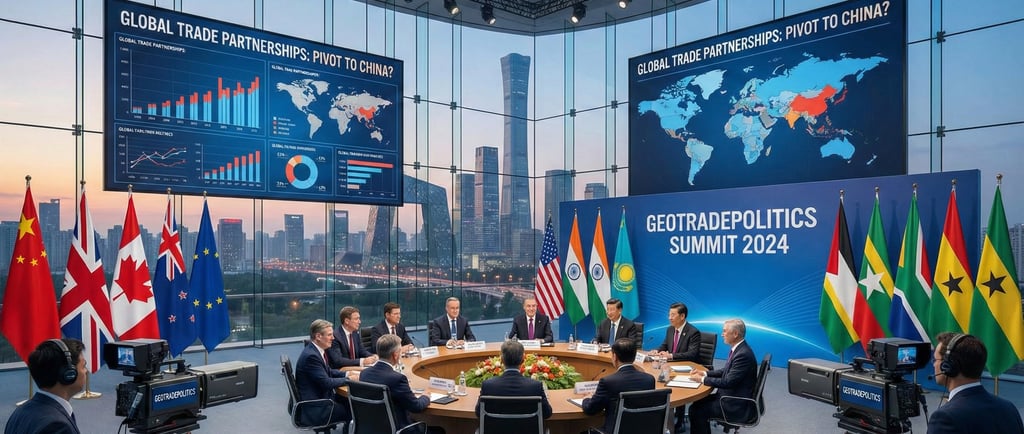
During the last few months, many countries and economic blocs are rushing to China and exploring trade partnership, giving a feel of what is being discoursed across the world as “China pivoting”.
At times, it appears as if China has come to diversifying trade away from the United States, particularly after President Donald Trump’s tariff. It also sometimes gives a feel of reorienting diplomatic relations globally.
Geotradepolitics.com, with this article, tries to explore in order to find out whether “China pivoting” is a myth or a reality.
Prime Minister Starmer and Prime Minister Carney Visit President Xi
Britain Prime Minister Keir Starmer undertook a four-day visit to China and also met with Chinese President Xi Jinping. Prominent outcomes include China will lift restrictions that it had imposed on a group of lawmakers, and that the lawmakers are now free to travel China.
The two leaders are known to have pledged greater cooperation on trade, investment and technology to the mutual benefit of both countries. Starmer’s visit also is learnt to have managed get lower tariff on whiskey.
Just before the British Prime Minister Starmer, his Canadian counterpart Mark Carney visited Beijing and struck a deal. At the World Economic Forum, Carney, an economist himself, without naming President Trump, had taken up the new world issues at the world forum. His lines even drew ire of the U.S. President.
The visit by the prime ministers of two important traditional partners of the United States is seen as the latest in world as China pivoting.
China on its part has been trying to paint itself as a ‘reliable partner’ in contrast with the United States.
The European Union, a rich economic bloc of the world, as the fact stands is a major trading partner and China is its largest trade partner.
Two days back, China’s foreign minister Wang Yi had maintained that China and European Union were partners and not rivals in a phone call to France’s Emmanuel Bonne, diplomatic advisor to the French President Emmanuel Macron.
China is a good connoisseur of French wine. Chinese roads have good share of German high-end cars. Both France and Germany do not want to lose their Chinese market.
However, China might not offer as a substitute for the U.S. market and the United States for many obvious reasons, for the Europe, the most important being its closeness with Russia that the whole of Europe is always warry off as far as security is concerned.
Secondly, though China might try to paint itself hard as a ‘reliable partner’ in contrast with the United States, Beijing being an export-heavy economy offer limited scope for its partners’ trade expansion and growth.
Interestingly, United States President Trump knows both the facts very well. He also knows that China will need the U.S. and so will the U.S. do with China.
Is China Pivoting?
China has been in a love-hate relations with the United States, for it has a huge market in the United States that it would like to maintain. On the face of Trump’s tariff, China itself has been looking everywhere else to compensate the loss it incurs due to the tariff in the United States.
On the other hand, another aspect of change too is getting more obvious.
During the last few months, trade, investment, and diplomacy are increasingly focused on the Global South instead of the West, in countries of Asia, Africa, the Middle East and Latin America. Though this process is not recent, the recent geo-trade-politics events, including the US-EU decoupling, have accelerated it.
While China itself has been consolidating itself in nations of Latin America and Africa apart from its own Asia, recent European Union-India free trade agreement points towards a shift in geo-trade to the Global South.
China has been using is rare earth metals as a weapon to keep itself relevant in geo-trade-politics with all nations, including its viable trading partners.
Despite spat in recent days, the U.S. and China continue to remain top trading partners, and China may not like to, at least now, disturb the equation as U.S. offers for it a huge market.
So, why Trading Blocs are Realigning themselves with China, India?
There have been opinions that the rushing to China, and India of trading blocs in the West might be a way of telling the U.S. that they are open to looking new ways.
However, given the huge trading importance that the US market offers to China, China might still to try to substitute it with some other or others.
The world of geo-trade-politics is a complex one, at the end of the day!