Iran Under Ayatollah Ali Khamenei
With the death of Ayatollah Ali Khamenei, a long and complicated chapter in the history of Iran has ended. The rule of Ali Khamenei might be remembered with sense of mixed emotions
GEO ANALYSISGEO POLITICSGEO SECURITYHOME PAGE
Team GTP
3/1/20263 min read
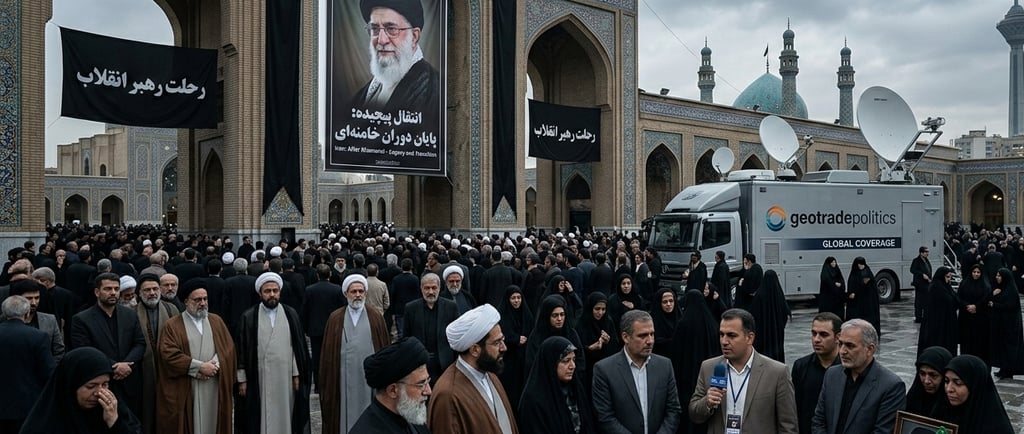
With the death of Ayatollah Ali Khamenei, a long and complicated chapter in the history of Iran has ended. The rule of Ali Khamenei might be remembered with a sense of mixed emotions.
Born in 1939 in Mashhad, Iran, into a religious family, Ali Hosseini Khamenei trained as a Shiʿite cleric in Qom, a major center of Islamic scholarship, and became involved in anti-monarchy political activism in the 1960s and 1970s.
Before the 1979 Islamic Revolution, Iran was ruled by the Pahlavi family. Prince Reza Pahlavi, who now lives in exile in the United States, had been an active voice of resistance to the Islamic cleric rule of Ayatollah Ali Khamenei.
At the birth of Islam in 611 CE, Iran was being ruled by the Sasanian Empire (224-651 CE), borders of which spanned from the Euphrates River and upper Mesopotamia in the west to the Indus River in the east, with its core in modern-day Iran and Iraq. At the peak of the rule of the dynasty, the borders of the dynasty touched the Caucasus, Central Asia, and even Egypt, Yemen, and the Arabian Peninsula, and is supposed to have acted as a major, often hostile, neighbour to the Roman, Byzantine Empire.
Pahlavi dynasty was the last ruling dynasty of Iran, and ruled for 54 years from 1925 until the Islamic Revolution in 1979 that overthrew the rule of the Pahlavis.
The Pahlavis ruled as autocrats, but pro-Western in lifestyle and modernized and secularized Iran. This was one of the reasons of the discontent of the orthodox which eventually gave rise to what is known as Islamic Revolution that overthrew the modernized and secularized rule of Pahlavis and established the Islamic Republic of Iran. Religion came to play the upper hand in all walks of life including politics.
From 1979 to 1989, Iran was ruled by Ayatollah Ruholla Khomeini as the first supreme leader of the Islamic Republic of Iran after the revolution.
After Khomeini’s death in June 1989, he was succeeded by Ayatollah Ali Khamenei, until his death in the U.S.-Israel strikes on February 28, 2026 (Saturday).
How Iran Lived Under Ali Khamenei
After the Revolution, the cradle of one of earliest human civilizations that Iran once was, then known as Mesopotamia, went through a complete transformation from a modernized and secular country to a theocratic Islamic Republic, where the ultimate political and religious authority was held by Ali Khamenei.
Ali Khamenei emerged as one of the most powerful figures in Iran’s modern history, and shaped Iran’s politics, society, and foreign relations. He wielded final control over every thing of Iran, outranking even the president and the parliament.
The cleric regime of Khamenei completely changed life from what it used to be before the Revolution. Morality policing enforced social codes in public spaces like universities, parks, and markets.
Hijab and modest dress became compulsory, as a matter of rules for women. Women had to appear in public spaces with careful attention to dress laws, failing which they invited punishment. The rules were so strict that they at times attracted resistance from women groups, including resistance movements like the 2022’s “Woman, Life, Freedom,” demanding more autonomy and civil rights. Young Iranians are known to have often taken to the underground to express themselves through music, fashion, humour, and private social gatherings.
Restrictions were imposed on free speech, press freedom, and political activism.
Iran for a long time during the cleric regime attracted long list of sanctions from the United States and Europe, that led to inflation and currency devaluation. Families went into extreme hardships due to rising cost of living.
Will there be a Regime Change in Iran?
Ayatollah’s cleric rule has gone deep in Iran, and has created large and wide rank and file not just in administration, but in all walks of public life. Thus, ending Ayatollah might not be similar to ending the regime he presided over.
The cleric rule’s opposition lives mostly in migration, and prominent resistance leaders like Reza Pahlavi in exile. The opposition to the orthodox and suppressive cleric regime has so far remained fragmented, some of who live in cities of other countries including the United States and Europe. Reza Pahlavi himself lives in exile in the United States and tries to become the voice of regime change. Due to the diversity of the opposition to the cleric regime of Iran that until Saturday was presided over by Ayatollah Ali Khamenei, the possibility of coming to one line of political thinking looks remote.
Effort to any regime change has to come from home in Iran, and not from among the exiled or from the other countries. But back home, most people in Iran are mourning the death of the supreme leader, even as people in exile and in migration celebrating.
A regime-change needs foot soldiers on the ground, and neither the United States nor Israel would be willing to set their boots on the ground.