Himalayas Get the Much-awaited Snowfalls, Apples to be Tastier
Lovers of Himalayan apples across the world, including those in the United States and Europe, must keep their knives ready.
GEO WEATHERGEO ANALYSISGEO INDIHOME PAGE
Aman Kumar
1/26/20264 min read
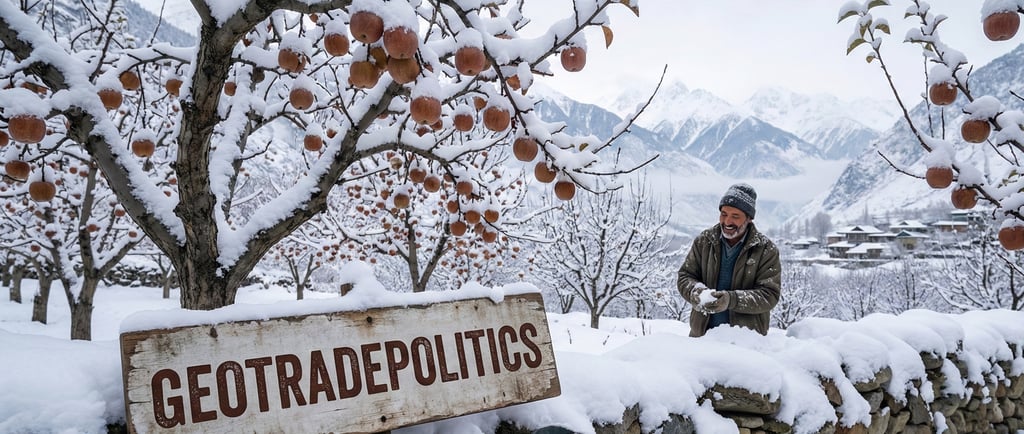
Lovers of Himalayan apples across the world, including those in the United States and Europe, must keep their knives ready.
Though delayed this season, the much-awaited snowfalls in the Himalayas have finally started, bringing joy on the faces of apple farmers who are passionate about only one thing—growing the best quality for world consumers.
Apple growers say snowfall is essential for their apples because it provides the required chilling hours for uniform flowering, protects roots from extreme cold, promotes soil moisture and fertility. The snow also controls pests and diseases naturally and also improves fruit size, colour, taste and quality and eventually results in high yield.
Global warming has upset the Western Disturbances, a climatic process. Impact of it in the Himalayas delays snowfall which takes toll on poor apples.
Faced with snowfall deficit this season, Indian provinces of Himachal Pradesh, Uttarakhand and Jammu and Kashmir have finally started receiving the much-awaited and much-needed snowfall late this year.
Though very late, the snowfall has brought smiles on the faces of thousands of apple growers who have their apple orchards in these states in the Western Himalayan region.
Farmers call the snowfall a lifeline for their apple orchards.
As the first snowfall of this season graced Shimla and adjoining regions, the roads and mountains turned completely white. Orchard owners are delighted; apple trees are loaded with snow chips.
“Good yield is what a farmer wants,” says an apple grower based in Shimla, and explains, “Delayed snowfall will certainly affect the apple fruiting.”
Shimla was the summer capital of British India, officially declared so in 1864 by Viceroy John Lawrence, serving as the cool mountain retreat for the government to escape the oppressive heat of Calcutta, the capital on normal times. Then the city was spelt as Simla.
The best quality apples are exported, particularly to countries in Europe and America. T produce the export quality apples; early or timely snowfall is a must. The remaining apples are supplied across the sub-continent.
Not only the farmers, the delayed snowfall or snowfall deficit is a cause of concern for the climatologists and the nature lovers because it threatens glaciers, the climate variability, water security, agriculture.
The Mediterranean Connection of the Western Himalayas
What causes the snowfall deficit in the western Himalayas is weak and moisture-deficient Western Disturbances—a climatic process, which are extratropical storms originating in the Mediterranean region that bring essential winter rain and snow to the northern Indian subcontinent between December and April.
Driven by the subtropical westerly jet stream, they travel eastward, collecting moisture from the Mediterranean, Caspian, and Black Seas.
If snowfall is delayed, it affects the health of glaciers, rabbi agriculture, forest stability, and Himalayan livelihoods. Therefore, delayed snowfall warns to protect the environment by making climate-adaptive policies and their effective implementation.
Western disturbances are large eastward-moving rain-bearing wind systems or extra-tropical weather systems that originate over the Mediterranean Sea, Black Sea, and Caspian Sea. They are low-pressure systems embedded in the Westerly Jet Stream.
During winter, the jet stream steers these disturbances eastward toward the Indian subcontinent. While travelling across West Asia, Iran, Afghanistan, and Pakistan, they accumulate moisture. When they finally encounter the Himalayan barrier, the air is forced to rise, cool, and condense, producing rainfall over the plains and snowfall at higher altitudes.
Due to this west-to-east progression, Kashmir typically receives snowfall first, followed by Himachal Pradesh and Uttarakhand, and occasionally Nepal and parts of Northeast India.
Last Friday, the first snowfall of the season occurred in Shimla, a beautiful region of the Himalayas that the British during in India had made their summer capital.
The snowy scenes in Shimla are expected to last for some days. Government officials said that light snowfall is occurring in the higher reaches of Lahaul-Spiti, Chamba, Kullu, Kinnaur, Sirmaur, Mandi, and Shimla districts.
Meanwhile, Jammu and Kashmir is experiencing heavy snowfall these days. Moderate to heavy snowfall in the higher reaches of the Jammu region, including the Mata Vaishno Devi temple, led to the closure of several important roads to traffic. This also affected air and rail traffic. Officials said that more than 100 stranded people were rescued from snow-covered areas of Poonch and Udhampur districts.
Moderate rainfall occurred in the plains, including Jammu city, ending the dry spell that had lasted for more than two months.
Himachal Pradesh witnessed the first snowfall of the season on Friday. After a long dry spell, the spell of rain and snowfall has finally begun. The Dhauladhar hills of Kangra district are completely covered with a white sheet of snow. It looks as if someone has adorned Kangra with a shining silver crown. Jammu and Kashmir is also bustling with snow these days.
Moderate to heavy snowfall is occurring in the higher reaches of the Jammu region, including the Mata Vaishno Devi temple area.
First snowfall of the season in Dhauladhar
Himachal Pradesh's Kangra district is situated in the lap of the Dhauladhar range of the Himalayas. For a long time, the people here had been waiting for rain and snowfall. December and January had almost passed. Tourists longed to see snowfall in the mountains. From Christmas to New Year, everything felt desolate without snow. But now nature has showered its blessings. The mountains are looking vibrant with the snowfall.
Rain and snowfall in the hilly areas of Nainital district on Friday brought relief to farmers. The rain in Dhanachuli, Paharpani, Mukteshwar, Ramgarh, Hartola, Nathuwakhan, Managher, and Nai areas provided much-needed moisture to wheat, mustard, barley, peas, and potato crops. Apple growers are also happy with the snowfall.