Global Foreign Trade Competition Set to Get Tougher
China’s Revision of its Foreign Trade Law will Increase Trade War
GEO ANALYSISHOME PAGE
Team GTP
12/31/20253 min read
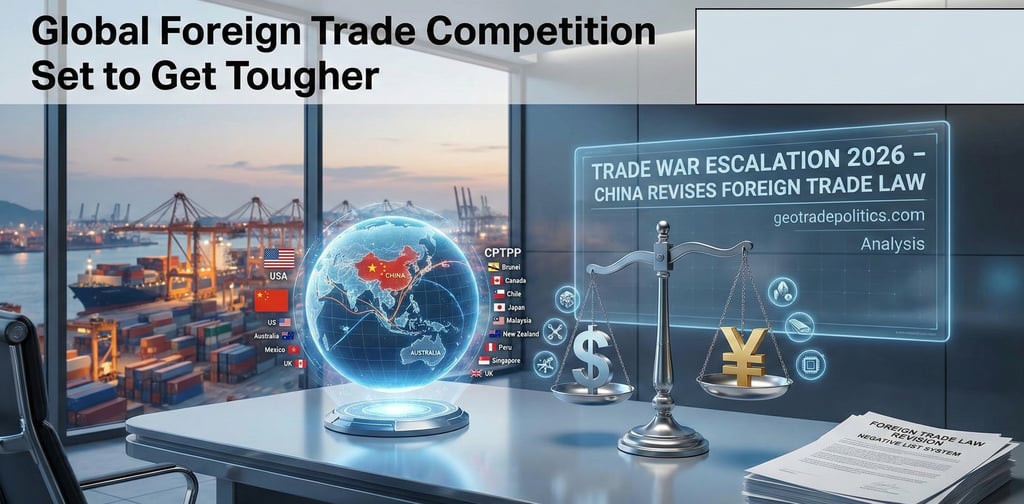
With China passing a revision of its Foreign Trade Law, one can expect trade war at a higher scale in the New Year 2026.
World’s manufacturing giant appears to have made up its mind to be more aggressive in its foreign trade taking a leaf out of its experience with the United States. The U.S. so far had been China’s largest foreign trade partner.
Geotradepolitics.com attempts an analysis as to how the global foreign trade scenario will evolve in the coming days with China, the manufacturing capital of the world, revising its foreign trade law.
China has Learnt a Lesson
The United States had been the biggest foreign trade partner of China so far. However, with the return of President Donald Trump and his protectionist policy, China learnt a lesson. Trump’s high tariff upon Chinese imports, which in fact is an effort to restrict Chinese trade surplus, has driven China to look for alternatives. It now wants expansion of its foreign trade elsewhere.
China has earlier made agreements for trade cooperations with nations like South Korea, Japan and even India in order to counter U.S. tariff. China’s long-term aim is to reduce its dependence on the United States for export.
Wants to Expand its Trade Cooperation with Trans-Pacific Nations
As per reports, China with the revision in the Foreign Trade Law focuses on frameworks that are consistent with the international trade practices. By doing so, China wants to align itself with foreign trade practices of a rich trading group—the members of the Comprehensive and Progressive Agreement for Trans-Pacific Partnership (CPTPP). At present the group has 12 members—Australia, Brunei, Canada, Chile, Japan, Malaysia, Mexico, New Zealand, Peru, Singapore, the UK, and Vietnam, which form a major free-trade bloc in the Indo-Pacific region.
The agreement remains open, with countries like China, South Korea, and others expressing interest in joining.
China-U.S. Trade Rivalry to Increase
China basically wants to circumvent the U.S. tariff, but not let go of its grip over foreign trade. China, the power-house of manufacturing already has its domination in huge markets like India. The U.S. also has trade cooperations with (CPTPP) nations as well India. Earlier, the U.S. had withdrawn itself from (CPTPP). China is aiming to enter the trading bloc.
Thus, the new international trade scenario gears up for a further escalation in trade war between the United States and China.
Beijing now has a stronger legal basis for retaliation, such as restricting exports of rare earth minerals to the US in response to American tariff increases.
China’s Foreign Trade Law
China's foreign trade policy blends market liberalization with strong state control, focusing on high-quality development, national security, and global integration.
The law exercises control strategic exports like rare earth minerals which will hurt the U.S. and many other nations alike. In fact, in areas of digital promotion and electronic vehicles, semi-conductors, defense equipment and more where rare earth elements are used, China would be holding the key to global supply chain—and this time more tightly.
China’s Revised Law will Force Other Countries to Revisit their Policies
China’s revision of its foreign trade law is expected to have its impact on the foreign trade policies of other nations and trading blocs. Moreover, trading blocs will align and realigns themselves that for sure will increase foreign trade competition in the coming days.
For countries majorly dependent on China for rare earth minerals, they will have to start looking for alternative sources and exporters. As rare earth mineral is a monopoly of China, and with the world’s manufacturing sector revolving around rare earth minerals, China is the biggest player. In the past, China has used rare earth to dictate trade terms.
Shifts in Global Trade
There well could be a possible shift in global trade and trade cooperation alignments. China’s new policy could influence other nations the way they approach trading with China.
The ‘Negative List’ System
This system opens selective and valuable foreign investors in Chinese manufacturing. The system envisages reduced administrative ambiguity, and is solely market driven.