Eyes on Resource-Rich Greenland may Intense Turmoil in Geo-politics
In this article we explain Greenland, a panoramic part of the Earth covered with glaciers, may lose its natural beauty in next four decades for two reasons. First, global warming; and secondly, race for resource.
GEO WEATHERHOME PAGEGEO POLITICSGEO ANALYSIS
Kirti Singh
1/23/20263 min read
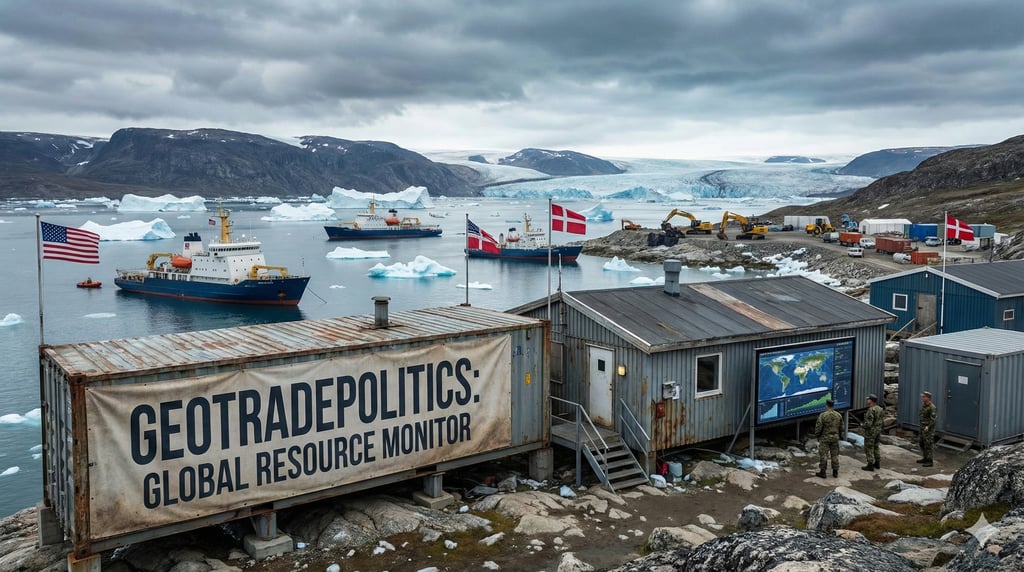
Greenland, a panoramic part of the Earth covered with glaciers, may lose its natural beauty in next four decades for two reasons. First, global warming; and secondly, race for resource.
The human greed is a major cause of genesis of turmoil across the globe. The natural resources of the Greenland, though not visible at present, are in the eyes of human being.
As a result, tensions between Europe and the United States may increase in near future—process of which has already started. This strain might even affect the unity of the North Atlantic Treaty Organization (NATO).
The Greenland, an autonomous territory under Denmark, is an important mineral rich part of the Earth.
The United States wants to control at any cost. Owing to it, America and Denmark—both NATO members—are on a collision course. Any military action against Denmark would be treated as an attack on all NATO allies, including the US and the UK themselves. The root cause remains the same old but powerful one: strategic location combined with valuable minerals.
Greenland is the world's largest island, with about 80% covered in ice and a population of less than 60,000. United States President Donald Trump has reiterated, “For national security, we need Greenland.” His argument is that it holds exceptional strategic importance in the Arctic region. However, the aggressive stance, though not fully shared across the US, is fundamentally about strategy and economics.
The island sits between the Arctic Ocean and the North Atlantic, controlling the critical naval chokepoint known as the GIUK Gap (Greenland-Iceland-UK). The US operates the Pituffik Space Base here, with around 150 American troops stationed. This major military and space surveillance center forms a key part of the early warning system against Russian ballistic missiles. The US has been present since World War II, and its role could expand further with future missile defense networks, such as the proposed “Golden Dome.”
The complication is that official sovereignty over the entire area belongs to Denmark.
Climate change has further complicated the equation. Arctic ice is melting rapidly, opening new sea routes. At the same time, the US is eyeing the vast rare earth minerals that could be mined on a large scale once the ice recedes. In September 2025, Arctic sea ice extent ranked as the 10th lowest (or around 13th-14th in some records) in satellite history, with all of the last 19 lowest September extents occurring in the past 19 years.
Routes like the Northwest Passage are about 7,000 kilometers shorter than via the Panama Canal, while trans-polar routes could drastically cut travel time from Asia to Europe. In 2025, a Chinese ship used the Arctic route to reach Europe, roughly halving the journey time. Forecasts suggest the Arctic could be nearly ice-free in summers by 2040, unlocking new paths for trade, fishing, and military movements. In 2024, 1,781 ships transited the Arctic Polar Code area—about 500 more than in 2013.
Natural resources are the biggest draw in this contest. According to US Geological Survey estimates, Greenland holds approximately 1.5 million metric tons of rare earth reserves, placing it among the world's top eight. The Kvanefjeld area has reserves and resources exceeding 11 million metric tons of rare earth oxides (with a JORC-compliant resource of over 1 billion tonnes at 1.10% TREO). The Tanbreez deposit is estimated at 28.2 million metric tons of total rare earth oxides within a massive 4.7 billion-tonne host rock, making it one of the world's largest potential deposits (with over 27% heavy rare earths). Greenland contains 25 of the 34 critical raw materials listed by the European Commission, including uranium, iron, zinc, and gold—all essential for electric vehicles, wind turbines, and defense industries. Commercial rare earth mining has not yet started, but melting ice is making access easier each year.
Global competition is intensifying. China aims to expand influence through its Polar Silk Road, and in 2025, it tightened controls on rare earth exports, impacting global supply chains. Russia continues to ramp up military activities in the Arctic. The US blocked a Chinese buyer for the Tanbreez project, handing it to an American company, and in June 2025, the US EXIM Bank showed interest in providing up to $120 million in financing.
In this environment, if Trump adopts a more aggressive posture toward Greenland after the Venezuela campaign—or even discusses military options—it would not be surprising. Denmark has already warned that this could threaten NATO's stability. Meanwhile, Greenlanders strongly oppose American control and have long demanded greater autonomy.