Climate Change Fear, the Aravalli Hill Range Debate
India Government on Thursday imposed a complete ban on new mining leases in the Aravalli hill ranges, which in recent times had become the topic of an intense social media debate in India.
GEO INDIGEO ANALYSISHOME PAGEGEO WEATHER
Team GTP
12/25/20253 min read
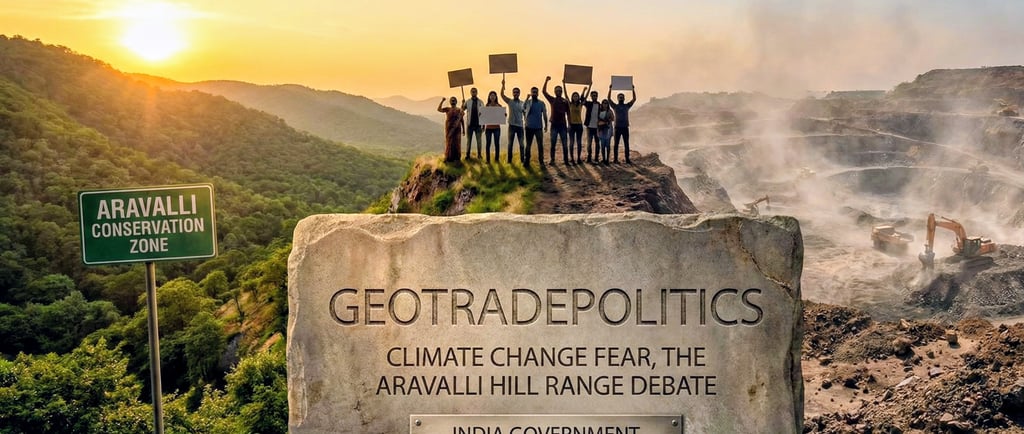
India Government on Thursday imposed a complete ban on new mining leases in the Aravalli hill ranges, which in recent times had become the topic of an intense social media debate in India.
Government of India’s Ministry of Environment, Forest and Climate Change in its statement said that ‘in view of the conservation and protection of the entire Aravalli range stretching from Delhi to Gujarat from illegal mining, the Union Ministry of Environment, Forest and Climate Change has issued directions to the States for a complete ban on the grant of any new mining leases in the Aravallis’.
The Background to the Debate
That rampant mining in hills and forests is an open secret in India, which has been creating many issues, not just environment but otherwise too.
But in the recent days, India witnessed an intense debate with regard to mining in the Aravalli hill range, and a judgment of the Supreme Court of November 20 in the ongoing TN Godavarman Thirumulpad vs Union of India case, became the background to the debate.
Basis for the Supreme Court’s judgment was the uniform scientific definition of the Aravalli hills and ranges proposed by a Ministry of Environment, Forest and Climate Change-led committee. The apex court had accepted the definition of Ministry of Environment, Forest and Climate Change-led committee in its judgment.
The court in its judgment accepted the “100-metre above local relief” criterion with contour-based mapping but also directed the Government’s Ministry to prepare a landscape-wide Management Plan for Sustainable Mining.
What Was the Debate For?
Social media debate and environment activists scored that the ‘100-metre’ criteria will open up a huge portion of the Aravalli hill range to mining activity and kill the very essence of the hill range. There had been intense public frustration and anger on the issue, spawned all over.
The Aravallis, One of the Oldest Mountain Ranges
The Aravalli hill range is located in the North-west India, covers provinces like Gujarat, Rajasthan, Haryana, Delhi with a length of about 800 kilometres.
The hill range rans from Southwest to Northeast. The highest peak is Guru Sikhar that stands at 1,722 metres in Mount Abu, Rajasthan.
The hill range is significantly recognised as one of the oldest mountain ranges in the world.
Aravalli’s geological age is said to be 1.5 to 2.5 billion years old, older that the Himalayas, Alps and Andes—which are said to be 50-million-year-old.
The Aravalli represents some of the earliest continental crust formation on the Earth.
Mining for What Minerals?
Miners eye the Aravalli hill range for metallic as well as non-metallic minerals.
The long list of minerals available there include Limestone, Quartzite, Marble, Copper, Zinc, Lead, Iron ore, Silver, Gold, Dolomite, Calcite, Gypsum, Talc, Asbestos, Granite, Slate among others.
What is the Climate Significance of the Aravalli hill Range?
The oldest hill range acts as a barrier against expansion of the Desert Thar.
They help reduce sand movement, dust storms, and desertification toward fertile regions of Haryana, Delhi, and western Uttar Pradesh.
The hill range intercepts the south-west monsoon winds, causing orographic rainfall in parts of Rajasthan, Haryana, and Gujarat.
Forested sections of the Aravallis help moderate extreme temperatures, especially in summer. They reduce heat intensity and create microclimates in nearby regions.
Groundwater Recharge: The hills promote rainwater infiltration rather than runoff. Many rivers and streams like the Banas, Luni, Sahibi originate or are sustained by the Aravallis, supporting water availability in dry areas.
Prevention of Soil Erosion: Vegetation on the hills stabilizes soil and prevents wind and water erosion, which is critical in semi-arid climates.
Ecological Balance and Carbon Sink: Forests of the Aravalli range act as a carbon sink, helping absorb CO₂. They support biodiversity, which strengthens ecosystem resilience to climate stress.
In a nutshell, the Aravalli Range plays a crucial role in controlling desertification, supporting rainfall, moderating climate, conserving water, and maintaining ecological stability in north-western India.
Its degradation poses serious climate and environmental risks.