Buddha Relics Open for International Exposure at New Delhi
Indian Prime Minister Modi today inaugurated an exposition of the relics of Lord Buddha Rai Pithora Cultural Complex, New Delhi.
GEO INDIGEO CULTUREHOME PAGE
Team GTP
1/4/20263 min read
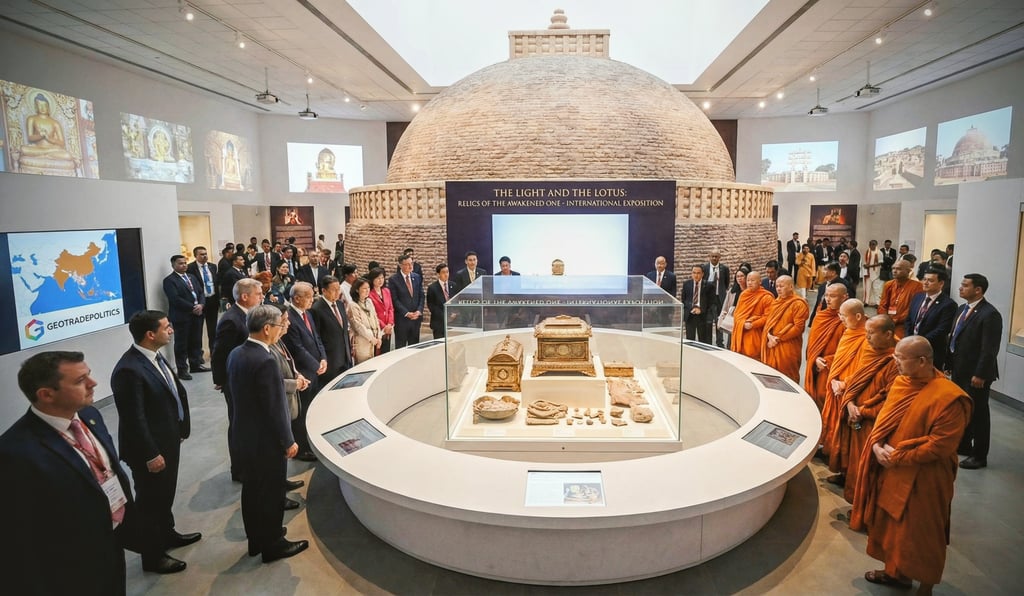
Indian Prime Minister Modi today inaugurated an exposition of the relics of Lord Buddha Rai Pithora Cultural Complex, New Delhi.
The international exposition of Lord Buddha’s sacred Piprahwa Relics, has been titled, “The Light and the Lotus: Relics of the Awakened One”.
Inaugurating the exposition, the Indian Prime Minister said, “The wisdom and path shown by Bhagwan Buddha belong to all of humanity.”
The Piprahwa relics of Lord Buddha had been repatriated after more than a century with authentic relics and archaeological materials from Piprahwa. The relics now have been preserved in the collections of the National Museum, New Delhi, and the Indian Museum, Kolkata.
Government of India and Godrej Industries Group Join Hands to Secure and Repatriate Revered Buddhist Relics.
On 30 July last year, The Ministry of Culture, Government of India, announced the historic return of the sacred Piprahwa relics of Lord Buddha to their rightful home in India.
The Piprahwa relics had been discovered in 1898 by British civil engineer William Claxton Peppé in Piprahwa, Uttar Pradesh in India, and are believed to be associated with the mortal remains of Lord Buddha.
The relics, however, had been slated for auction in Hong Kong in May 2025. This was when India decided to bring it back.
The Piprahwa relics hold a central place in the archaeological study of early Buddhism. These are among the earliest and most historically significant relic deposits directly connected to Lord Buddha.
With the inauguration of the international exposition of the sacred relics of the Buddha, India’s gates now are open for the international pilgrims to the national capital, New Delhi.
The exhibition is organised thematically. At its centre is a reconstructed interpretive model inspired by the Sanchi stupa, which brings together authentic relics from national collections and the repatriated gems.
Other sections include Piprahwa Revisited, Vignettes of the Life of Buddha, Intangible in the Tangible: The Aesthetic Language of Buddhist Teachings, Expansion of Buddhist Art and Ideals Beyond Borders, and Repatriation of Cultural Artefacts: The Continuing Endeavour.
To enhance public understanding, the exposition is supported by a comprehensive audio-visual component, including immersive films, digital reconstructions, interpretive projections, and multimedia presentations.
These elements provide accessible insights into the life of Lord Buddha, the discovery of the Piprahwa relics, their movement across regions, and the artistic traditions associated with them.
The Indian prime minister in his address noted that in Thailand, where such sacred relics were placed at different locations, in less than a month more than forty lakh devotees came for visit (darshan).
“In Vietnam, the public sentiment was so strong that the duration of the exhibition had to be extended, and in nine cities nearly 1.75 crore people paid homage to the relics. In Mongolia, thousands of people waited for hours outside the Gandan Monastery, and many wished to touch the Indian representatives simply because they had come from the land of Buddha.”
In Russia’s Kalmykia region, in just a week, more than 1.5 lakh devotees paid visit to the sacred relics.
In these events across different countries, whether common citizens or heads of government, all were united in equal reverence.
Modi recounted bowing at the sacred Maya Devi temple in Lumbini, Nepal, describing it as an extraordinary experience.
At To-ji Temple and Kinkaku-ji in Japan, Modi said he felt that Buddha’s message transcended the boundaries of time.
In China, the Giant Wild Goose Pagoda in Xi’an, was the place from where Buddhist scriptures had spread across Asia, and where India’s role is still remembered.
The Buddha
Buddha, born Siddharth Gautama (c. 6th-5th century BCE), was a prince in ancient India-Nepal who renounced his royal life to seek an end to suffering. After long years of sadhna, Siddharth Gautama
attained enlightenment under a Bodhi tree at Bodhgaya in India.
Buddha taught the "Middle Way," emphasizing mindfulness, ethics, and meditation to achieve Nirvana, becoming known as "the awakened one" and a spiritual leader rather than a god.
Spread of Buddhism
After the death of Lord Buddha, his teachings were spread far and wide by his disciples who lived in sanghas. His teachings spread far and wide in the whole of Asia and other countries.
So much was the originality of Buddha’s thoughts that most World Teachers who were born after him and taught ways of meaningful living, can be observed as influenced by Lord Buddha.
Noted philosopher and Teacher, OSHO, who through his teachings attracted a large number of followers, and whose followers in America even set up a city in his name—Rajnishpuram, too often referred to the teachings of Lord Buddha.