Aryans and Their Genes Draw Attention of Geneologists
A Study on Genes Reveal a Lot about Aryans
GEO INDIGEO ANALYSISHOME PAGE
Team GTP
1/3/20263 min read
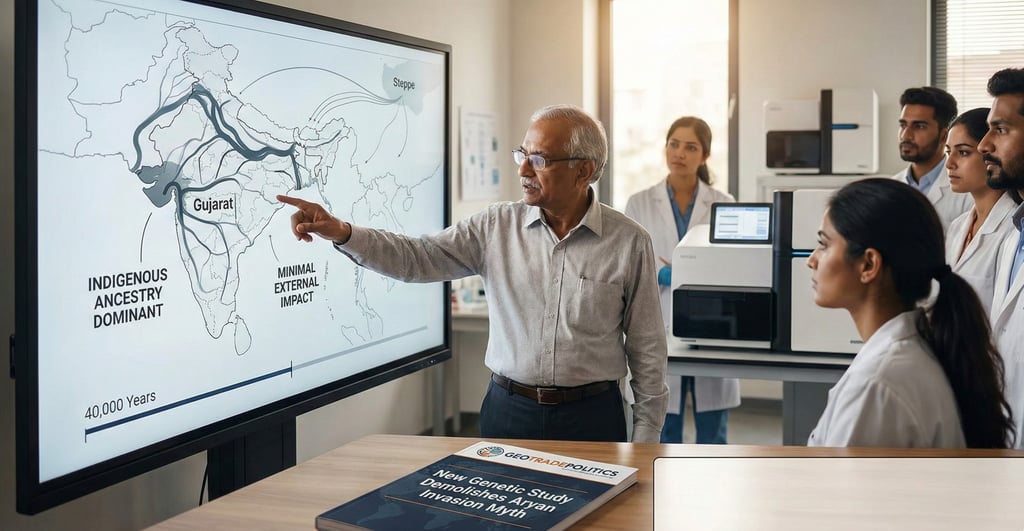

In a landmark genetic study that provides significant evidence to refute the long-debated Aryan Invasion Theory, researchers have unveiled compelling evidence that the maternal ancestry of Gujarat's population is overwhelmingly indigenous, with roots dating back to the Pleistocene era over 40,000 years ago. The research, published in the American Journal of Biological Anthropology, demonstrates that large-scale invasions or population replacements associated with Indo-Aryan migrations did not occur on the maternal side, challenging outdated models of India's ancient history. This study was co-led by scientists from Benaras Hindu University, Varanasi, and the National Forensic Sciences University, Gandhinagar. The study challenges colonial-era narratives that have long portrayed India's civilisation as the product of external conquerors.
A team of 16 scientists from the nine institutions globally have analysed 168 complete mitochondrial genomes from Gujarati individuals, supplemented by 529 additional sequences from across Eurasia and South Asia, revealing a story of remarkable continuity and stability.
The findings reveal that 76 per cent of maternal lineages are specific to South Asia, with contributions from East Eurasia at 0.6 per cent and those from West Eurasia at 21 per cent. Crucially, only 19 per cent of these West Eurasian lineages entered the region in the last 5,000 years, a period often linked to supposed Steppe migrations and Indo-Aryan influxes, while a staggering 81 per cent predate this era.
"This study fundamentally undermines the Aryan Invasion Theory by showing no evidence of significant maternal gene flow or demographic upheaval during the alleged Indo-Aryan period," noted lead author Shailesh Desai from Benaras Hindu University.
"Instead of a massive invasion overwriting indigenous populations as we see in Europe, our data points to small, staggered waves of gene flow over tens of thousands of years. Gujarat's maternal genetics reflect an enduring indigenous foundation, not conquest or replacement."
The Aryan Invasion Theory, popularised in the 19th century and refined in modern genetic studies, posits that Indo-European speakers from the Eurasian Steppe invaded or migrated en-masse into the Indian subcontinent around 3,500–4,000 years ago, bringing languages, culture, and genes that shaped modern South Asia. Proponents often cite West Eurasian genetic components as evidence, linking them to the spread of Indo-Aryan languages and the establishment of the caste system.
However, this new research directly refutes such claims on the maternal front. Extensive statistical analyses indicate a robust population expansion around 40–45,000 years ago, with no major disruptions during key historical periods, including the Last Glacial Maximum, the Neolithic transition, or the proposed Indo-Aryan migrations.
“We observed no substantive maternal demographic perturbations coinciding with these milestones," noted lead senior author Bhargav Patel from the National Forensic Sciences University. Even the decline of the Indus Valley Civilization (IVC) around 4,000 years ago left minimal genetic scars, suggesting continuity rather than collapse or invasion.
Phylogeographic analyses further dismantle AIT by tracing West Eurasian haplogroups like H, HV, T, W, and U to multiple, low-frequency entries from the Near East, Europe, and Central Asia, many predating the Holocene. For instance, haplogroup H2b, previously tied to Indo-Aryan movements, coalesces at ~6.2 kya and shows a broad distribution inconsistent with a single invasion. Similarly, W3a1b, associated with Steppe samples, is rare in South Asia and entered before the Holocene, rendering it "an unreliable marker for the spread of Indo-European languages."
The findings show bidirectional gene flow, India not only received but also exported maternal lineages to West Eurasia. This paints a picture of subtle interactions, not domination.
The dominance of South Asian-specific haplogroups M (48.21%), R (28.56%), and U (13.69%) underscores Gujarat's role as a Pleistocene gateway for early human migrations into India. These lineages, deeply rooted and endemic, affirm in situ diversification with minimal external influence. The study highlights connections, such as M33a merging with Iranian branches ~18,000 years ago, illustrating ancient outflows from India. Gujarat's strategic geography facilitated these ties, but the core maternal pool remained stable.
These revelations have profound implications for understanding India's genetic diversity, second only to Africa's. They suggest linguistic and cultural shifts, occurred with limited maternal genetic impact, possibly through male-mediated movements or cultural diffusion rather than invasion. The study aligns with recent re-evaluations of Indo-European origins, emphasising hybrid models over simplistic invasion narratives.
"This isn't just about genetics; it's about rewriting history free from colonial-era biases," Desai emphasized. "AIT has been weaponised to divide, but our data shows unity in India's ancient indigenous heritage."
(Professor Gyaneshwar Chaubey is currently teaching at the Department of Zoology, Benaras Hindu University, India. He is a Gene Scientist)