A Movie, ‘Ghoosh-khor Pandat’ Makes Bribery a Talking Point in India
A movie, all set to be released on Netflix in February, is in the eyes of storm. Reason, its title, Ghooskhor Pandat, ‘the Bribe-taker Pundat’.
GEO ANALYSISGEO INDIHOME PAGE
Aman Kumar
2/20/20266 min read
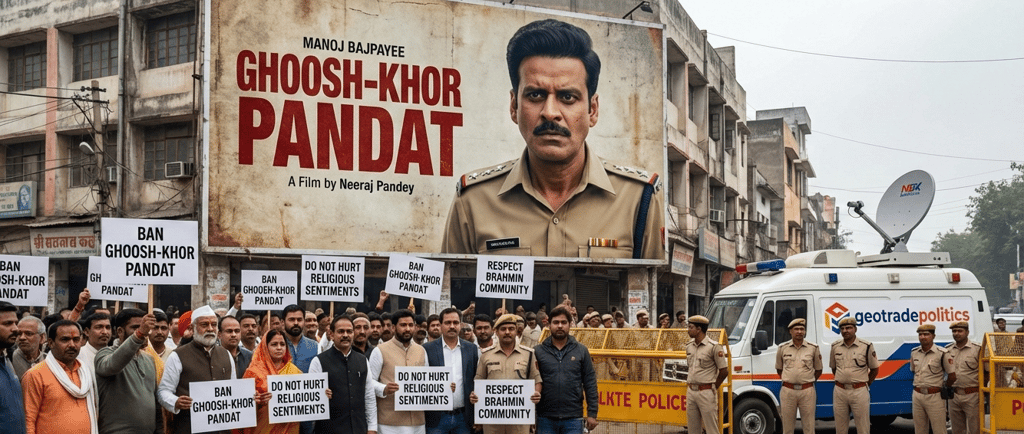

A movie, all set to be released on Netflix in February, is in the eyes of storm. Reason, its title, Ghoos-khor Pandat, ‘the Bribe-taker Pundat’.
It is facing a very strong protest across Northern India. A section of the Brahmin community strongly protests at Kashi, Bhopal, Mathura Lucknow and other parts of India, demanding a ban on the movie claiming it hurts their sentiments.
As the controversy intensifies, the ‘bribery’ is in focus. Though it is present everywhere, no one accepts it officially. The taker accepts it under the table and offeror hands it over sneakily or in a covert manner to get his work done.
Written, directed and produced by Neeraj Pandey, the movie has legendary actor Manoj Bajpayee in the lead role. Bajpayee plays the character of a corrupt police officer, Ajay Dikshit, who is famous as Pandit in police department, in the movie. The corrupt officer, after an incident as the movie shows, gives up bribery and becomes a good officer when some goons dump a girl along the road. As a sequence of events take place, the corrupt officer reaches the spot, and tries to help the girl.
In Lucknow, after the protests, an FIR has been registered against the movie.
It has been alleged that the film attempts to hurt religious and caste sentiments. Caste is a social classification in India based on the birth of a person. The Lucknow Commissionerate has stated that strict action would be taken against those who hurt community sentiments and disrupt peace and order of the society.
After the protests against the film's title, actor Manoj Bajpayee and producer and writer Neeraj Pandey shared on social media posts to clarify the situation. They have said that the story of 'Ghooskhor Pandit' is about a man with some flaws and has nothing to do with any caste or community.
Pandey also acknowledged through a social media post that the film's title had “hurt” a section of the audience and said that all promotional material for the film would be removed for the time being. The film's teaser is currently unavailable on Netflix's Instagram account.
The VHP (Vishwa Hindu Parishad), has objected to the movie 'Ghooskhor Pandit' (Bribe-taker Priest), calling it an attack on the "most respected" section of the Indian society. The VHP urged the government to look into the matter. VHP national spokesperson Vinod Bansal has said, "This is completely unacceptable. With the name of the series, you are not only attacking the most respected section of our Hindu society but also trying to spread hatred and unrest in the country. Stop this immediately and apologize, otherwise, the Hindu society will be forced to take democratic action against your repeated attempts."
Amid the row, the Indian government has asked the makers of the film to change its title. At the same time, the National Human Rights Commission too has issued a notice to the Ministry of Information and Broadcasting after receiving a complaint.
Amid the roles in the movie, bribery is a talking point in India.
Bribery in Human History
Bribery, defined as the corrupt solicitation or acceptance of favour to influence official action, has existed throughout human history as a persistent, global phenomenon.
Evidence dates back over 3,000 years to ancient Egypt, Mesopotamia's Code of Hammurabi, and Vedic India, where it was used to sway justice and distribute resources. Historically, it evolved from simple transactional gifts to complex political and corporate corruption.
Key Historical Developments in Bribery
Ancient Times: The earliest records show bribery was a recognized public issue in the first Egyptian dynasty (3100-2600 B.C.) and Ancient Greece. The Code of Hammurabi (~1754 BC) contains provisions against it.
Medieval Period: The term "bribe" originated from 14th-century French, referring to a "piece of bread" given to beggars, but evolved to mean illicit gains or tips.
17th–18th Century: In Britain, while laws like the Corrupt Practices Act of 1695 were enacted, electoral bribery remained endemic, with "treats" (food/drink) often used as bribes to influence voters.
Modern Era: Corruption became increasingly institutionalized in bureaucracies. The 20th century saw the development of stricter international laws, such as the U.S. Foreign Corrupt Practices Act (FCPA) and the UK Bribery Act 2010, designed to combat global corporate bribery.
Key Aspects and Examples
Evolution of Meaning: Historically, "corruption" held a broader meaning regarding immoral behaviour, while bribery focused on the direct, illicit influence of officials.
Prevalence: Studies indicate high instances of bribery in various sectors, with, for example, 62% of people in a 2005 Indian study reporting direct experience with paying bribes for public services.
Major Cases: Modern anti-bribery efforts have led to massive corporate penalties, such as cases involving Siemens AG, Goldman Sachs, and Glencore.
Legal Perspective: Modern definitions emphasize the "offer, promise, or gift" to gain an advantage in a position of trust.
Historically, bribery has been addressed through law but remains a significant, enduring challenge to governance worldwide.
This manuscript traces the historical evolution of corruption in India, from the Vedic age to the post-liberalization era in India. Corruption is an inbuilt system in the human mind, and it has persisted since civilization started. Corruption was accursed in texts like the Rigveda, the most ancient religious scripture in India, as a societal evil linked to poverty and deprivation.
Though Kautilya’s Arthashastra has no mention of the word “corruption,” it is the most comprehensive and detailed text about various forms of corrupt official practices, detailing 40 types of embezzlement and proposing stringent penalties for each of them. Kautilya was the Brahmin minister of Emperor Chandragupta Maurya, whose empire spread far beyond present day India into what we call the Middle-east today.
The Medieval India, under the Delhi Sultanate and Mughal Empire, struggled with corrupt revenue systems, aggravated by decentralized governance and Jagirdari abuses.
The colonial era under the British Raj institutionalized corruption through rigid administrative practices crafted especially to exploit the wealth of India and laid the foundation for systemic inequalities.
Post-Independence, the License Raj fostered bureaucratic corruption. Post-1991 liberalization, crony capitalism became apparent. India is still struggling to counter this system, which is deeply rooted in politics, society, and administration in various forms.
Discourse on Bribe in Scriptures
India’s most ancient scripture, the Rig Veda states that the thieves of God (bribe givers/takers) become insensitive to hydra-headed corruption and resort to extravagant worship and donations/gift culture to gain social recognition.
In other words, people involved in bribery, both bribe givers and bribe takers, are equally responsible for their sins. These people are overly indulged in temporary pleasures and are ignorant of the evil of corruption. Corrupt people are motivated by materialistic things and flashy lives. To attain a definite and spectacular social status, they are willing to deviate from the path of truth. Rig Veda also states that "when even one human being dies of starvation, it is a signal that corruption has crept into society".
Sama Veda (verses 179 and 913) again characterize ‘corruption’ as hydra-headed, meaning having nine heads (nine variations), and it corrupts human body through five sense organs.
Rigveda also mentions 99 vritras or powers of evil in 1-84-13. It describes in 1-104-3 that receiving or demanding bribes for money belonging to the state is a misappropriation of government money or public funds.
Anyone who take bribes or force others to give them bribe are thieves of God and they get rebirth in filthy womb; says the Bhagavad-Gita, another revered scripture.
Rigveda (3-34-6) and Yajur Veda 30-22 advise that corrupt people should not be permitted to live with common civilians (people following Chatvar Varnasharam) because they follow four divine professions. Yajurveda (30-19) and Rigveda (5-61-8) strictly dictate that those persons who praise and justify corruption are also corrupt and one should stay away from them. Rigveda (1-42-4) even mentions that one should stay away from teachers or Gurus (preceptors) who take donations/charity because it is also considered as a form of bribe.
The Later Vedic period saw the emergence of territorial kingdoms and a more structured administration, with taxation and land grants becoming common. Corruption manifested as misappropriation of taxes and abuse of power by local officials. The “Atharvaveda” (c. 1000 BCE) refers to dishonest officials (“dasyus”) who exploit subjects through excessive taxation.
The “Shatapatha Brahmana” (c. 800 BCE) critiques priests demanding excessive ritual fees, indicating early bureaucratic corruption. The “Aitareya Brahmana” (c. 800 BCE) describes a king withholding tribute from vassals, suggesting embezzlement in royal treasuries. Corruption in tax collection burdened agrarian communities, particularly non-Kshatriya groups, leading to economic disparities.
Mauryan Empire (c. 321-185 BCE)
The Mauryan Empire, under rulers like Chandragupta Maurya and Ashoka, developed a centralized bureaucracy with extensive taxation, trade regulation, and public works. This complexity fostered corruption, which Kautilya addressed in his seminal text, “Arthashastra”.
Kautilya's “Arthashastra” (c. 300 BCE) is a critical source, detailing 40 types of embezzlement (“sanchara”) by officials, including bribery, tax evasion, and falsifying accounts. Book 2, Chapter 8, lists penalties for corrupt officials, such as fines or exile. Kautilya notes, "Just as fish moving underwater cannot be detected, so too officials misappropriating revenue are hard to catch" (“Arthashastra” 2.9).
The “Arthashastra” describes corrupt “Adhyakshas” (superintendents) inflating project costs, such as in irrigation works, to siphon funds. Kautilya's spies (“Gudhapurushas”) were deployed to detect such malpractices. The Mauryan tax system, collecting 25-33% of agricultural produce, was prone to leakage, with estimates suggesting 10-15% misappropriation by local officials.
In the Medieval India
The Delhi Sultanate (1206-1526) and Mughal Empire (1526-1857) developed sophisticated bureaucracies with jagirdari (land revenue) systems, which were prone to corruption. The Mughal period, culminating with Bahadur Shah Zafar saw widespread administrative malpractices.
To conclude,
The movie, Ghoosh-khor Pandat draws its theme from all over, cutting across geography and historical eras.